
Have you ever noticed that when you cry, your nose starts running? That’s not just a coincidence. There’s actually a highway system inside your head that connects your eyes directly to your nose, and when this system gets blocked or overwhelmed, you end up with watery eyes all the time. If you’ve been dealing with excessive tearing that won’t go away, you might be experiencing something called epiphora.
Today, we’re going to explain watery eyes, exploring what causes them, how your body’s incredible tear system works, and most importantly, what you can do about it. By the end of this article, you’ll understand exactly why your eyes might be producing too many tears and what steps you can take to find relief.
What is Epiphora?

First, let’s talk about what epiphora actually means. Epiphora is simply the medical term for excessive tearing or watery eyes. It’s when your eyes produce more tears than they should, or when the tears that are produced can’t drain away properly. Think of it like a bathtub with the faucet running. If the water is flowing too fast or the drain is clogged, the tub will overflow. That’s exactly what’s happening with your eyes.
Before we get into what goes wrong, let’s understand how this system normally works.
How Your Tear System Works
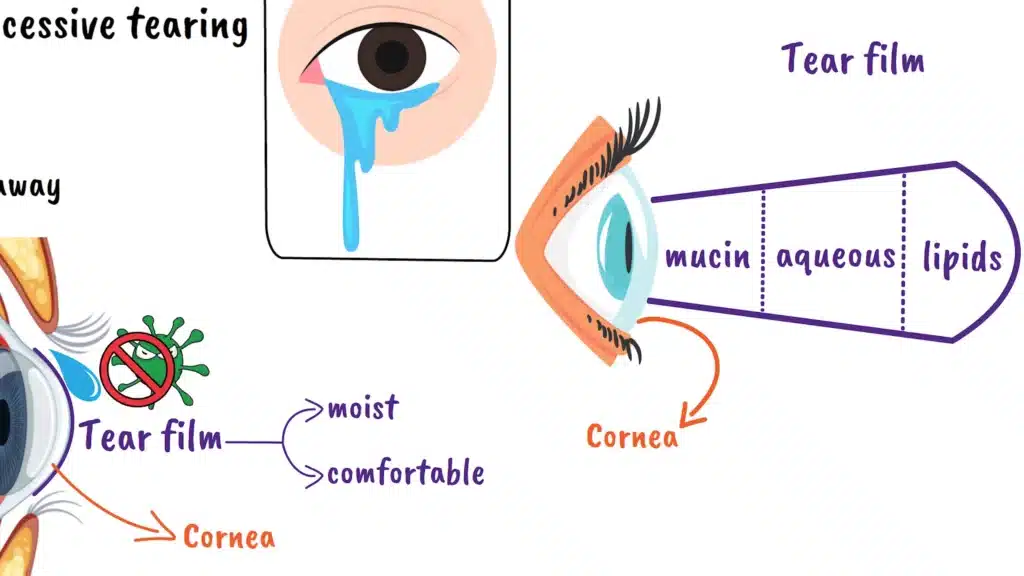
Your eyes are constantly producing tears, even when you’re not crying. These tears form a thin film over the surface of your eye that serves multiple crucial purposes. This tear film keeps your eyes moist and comfortable, provides nutrients to your cornea, helps you see clearly by creating a smooth optical surface, and protects your eyes from bacteria and other harmful substances.
The tear film itself is made up of three distinct layers, each with its own important job. The innermost layer, right against your eye, is made of mucin. This mucin layer helps the tears stick to your eye surface properly. The middle layer is the aqueous layer, which is mostly water mixed with proteins, electrolytes, and antibodies. The outermost layer is made of lipids or oils. This oily layer prevents your tears from evaporating too quickly, kind of like how oil floating on water prevents the water underneath from evaporating rapidly.
The Journey of a Tear
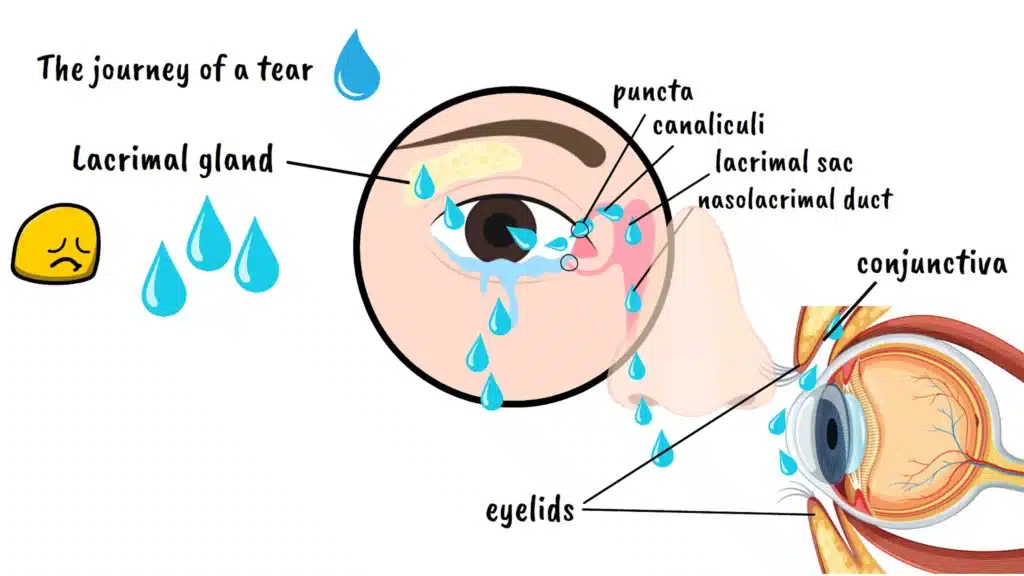
Now, let’s follow the journey of a tear from start to finish. Tears are produced primarily by your lacrimal gland, which sits in the upper outer corner of your eye socket, just under your eyebrow. This gland is constantly making tears. When something irritates your eye or you become emotional, this production can increase dramatically.
Once the tears are produced, they flow out through tiny ducts onto the surface of your eye, specifically into the upper part of your conjunctiva, which is that clear membrane covering your eye. Every time you blink, your eyelids act like windshield wipers, spreading these tears evenly across your entire eye surface.
After the tears have done their job of moisturizing and protecting your eye, they need to go somewhere. This is where the drainage system comes in. In the inner corner of each of your upper and lower eyelids, there are tiny openings called puncta. These are so small you need to look closely in a mirror to see them, but they’re there.
From these puncta, the tears flow into even smaller tubes called canaliculi. Think of these like the small pipes under your kitchen sink. The upper and lower canaliculi usually join together to form what’s called a common canaliculus, which then empties into a small sac called the lacrimal sac.
This lacrimal sac sits in a small depression in the bone near the inner corner of your eye. From there, tears continue their journey down through the nasolacrimal duct, which is essentially a tube that runs through the bones of your face and empties into your nose. This is why your nose runs when you cry. The excess tears that your drainage system can’t handle fast enough overflow onto your cheek, but the tears that do get drained end up in your nose.
This entire drainage system depends on your eyelids working properly. When you blink, your eyelid muscles contract and actually help pump the tears through this system.
What Causes Epiphora?
So what goes wrong in epiphora? There are actually several different things that can cause excessive tearing, and understanding the cause is crucial for finding the right treatment.
Tear Overproduction
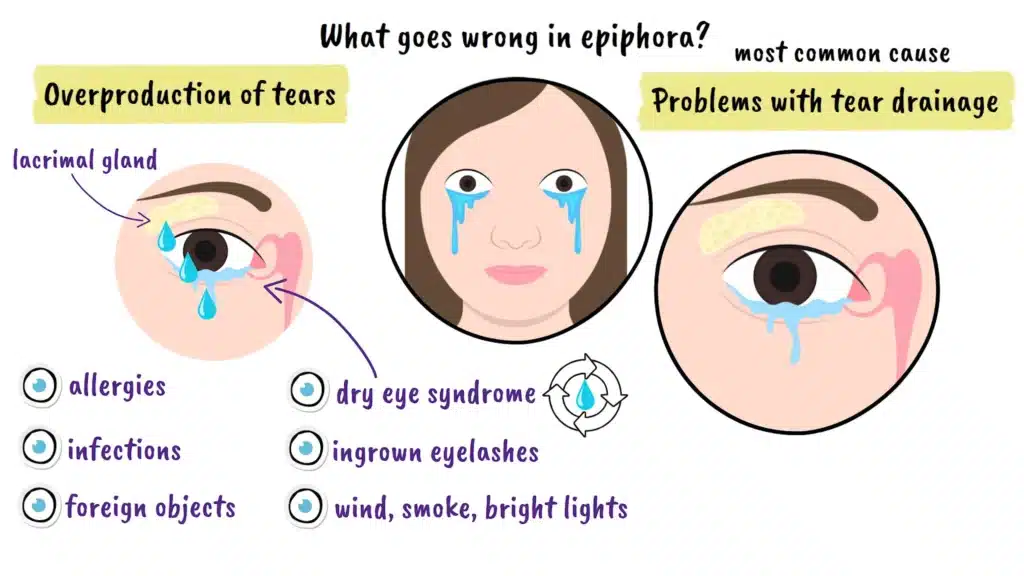
The first major category of problems involves overproduction of tears. This happens when something irritates your eye and triggers your lacrimal gland to go into overdrive. Common irritants include allergies, infections, dry eye syndrome, foreign objects in the eye, ingrown eyelashes, or environmental factors like wind, smoke, or bright lights. Interestingly, dry eye syndrome often causes watery eyes because your eye senses that it’s too dry and tries to compensate by producing more tears. However, these reflex tears don’t have the same composition as normal tears, so they don’t actually solve the dryness problem, leading to a cycle of dryness and excessive tearing.
Tear Drainage Problems
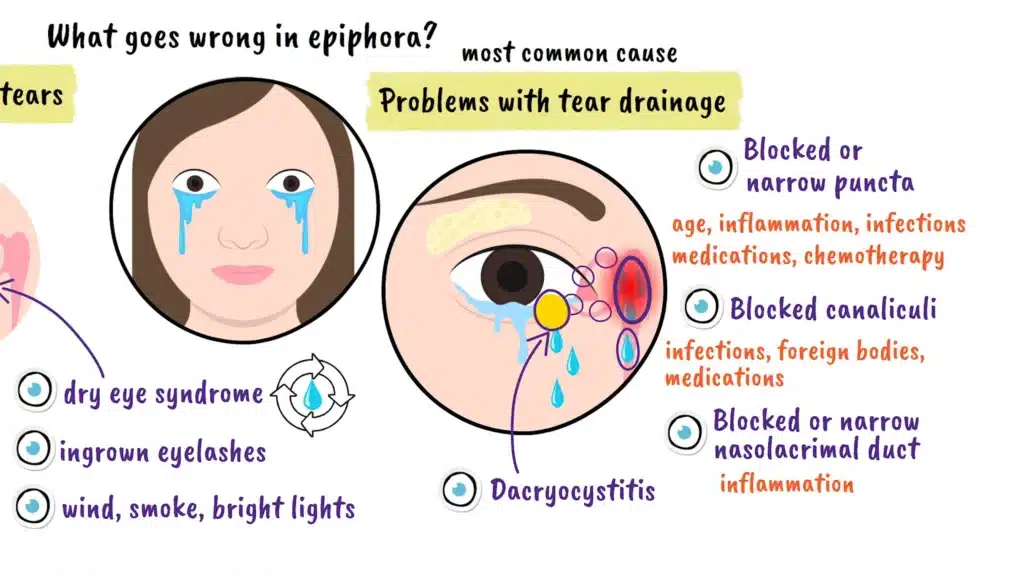
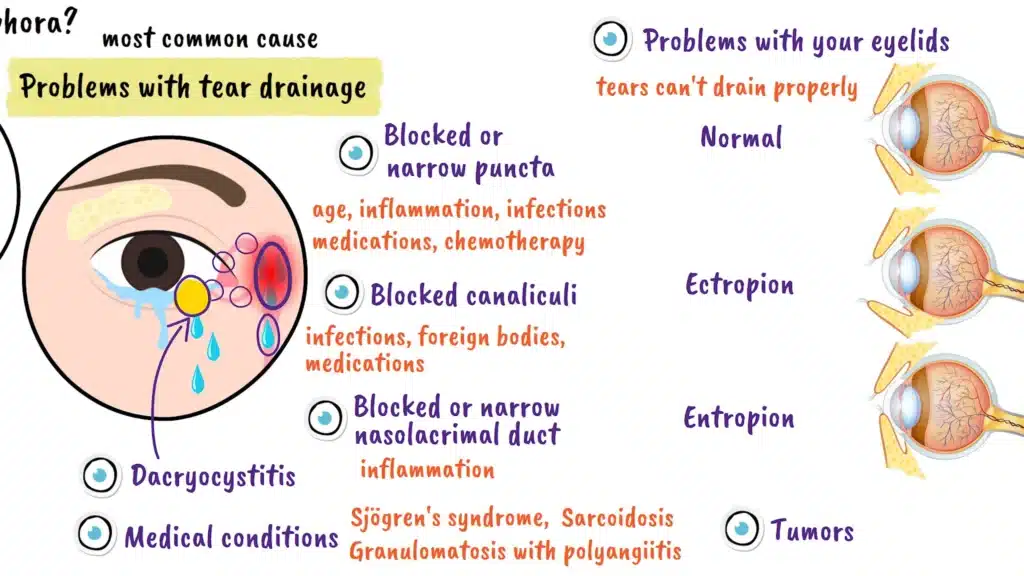
The second major category involves problems with tear drainage. Even if your eyes are producing a normal amount of tears, if they can’t drain away properly, you’ll end up with watery eyes. This is actually the most common cause of persistent epiphora in adults.
Drainage problems can happen at any point along that pathway we described earlier. The puncta, those tiny openings in your eyelids, can become blocked or too narrow. This can happen naturally with age, or it can be caused by inflammation, infections, certain medications, or even some types of chemotherapy.
The canaliculi, those small drainage tubes, can also become blocked. This might happen due to infections, foreign bodies, or certain medications. Sometimes people who use certain types of eye drops for glaucoma or other conditions can develop blockages in these tubes.
Further down the drainage pathway, the nasolacrimal duct can become blocked or narrowed. This is actually the most common cause of persistent watery eyes in older adults, especially women. As we age, this duct can gradually narrow due to inflammation, and eventually, it becomes so narrow that tears can’t flow through properly. When this happens, tears back up in the system and overflow onto the face.
Sometimes the lacrimal sac itself can become infected, a condition called dacryocystitis. When this happens, the area near the inner corner of your eye becomes swollen, red, and painful. You might also notice thick, sticky discharge coming from your eye.
Eyelid Problems
Problems with your eyelids can also cause epiphora. Your eyelids need to be in the right position and have the right tension to work properly as part of the tear drainage system. If your lower eyelid turns outward, a condition called ectropion, or inward, called entropion, the tears can’t drain properly. Similarly, if your eyelids become too loose or floppy with age, the pumping mechanism that helps move tears through the drainage system doesn’t work as well.
Medical Conditions
Certain medical conditions can also contribute to epiphora. Autoimmune diseases like Sjögren’s syndrome, sarcoidosis, or granulomatosis with polyangiitis can cause inflammation that blocks the tear drainage system. Tumors, though rare, can also obstruct the drainage pathways.
Diagnosing Epiphora
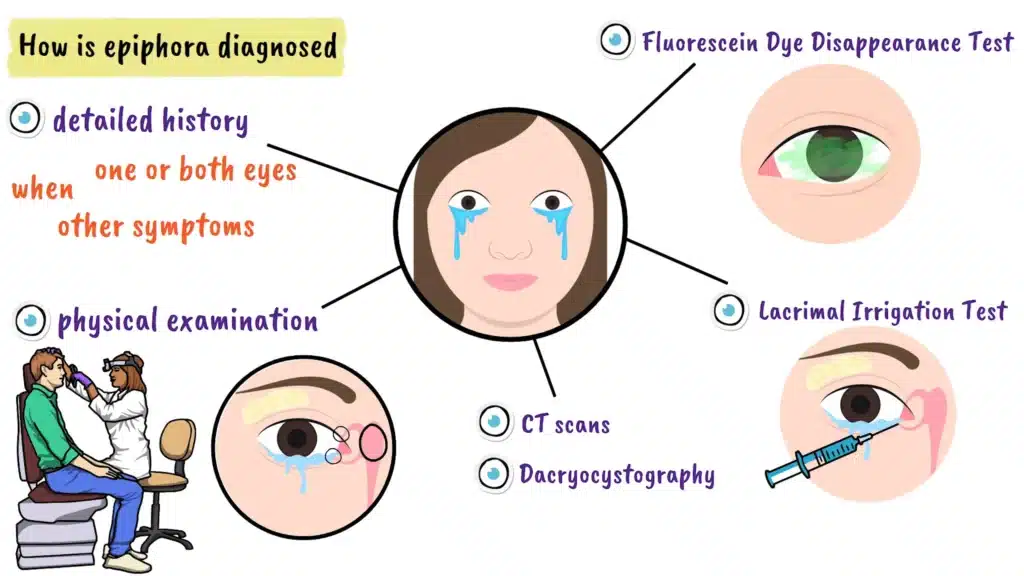
If you’re experiencing persistent watery eyes, an eye care professional will start by taking a detailed history. They’ll want to know when the tearing started, whether it affects one or both eyes, what makes it better or worse, and whether you have any other symptoms.
The physical examination will focus on your eyes and the surrounding structures. The doctor will look at your eyelids, check the position of your puncta, examine your eye surface, and feel around the lacrimal sac area to check for swelling or tenderness.
There are several specific tests that can help determine where the problem lies. One common test involves putting a special dye in your eye and watching how quickly it disappears. Normally, this dye should be gone within a few minutes as your tears wash it away. If it stays around longer, it suggests a drainage problem.
Another test involves irrigating the tear drainage system with saline solution to see if it flows through properly. This can help identify exactly where a blockage might be located.
For more complex cases, imaging studies like CT scans or specialized tests called dacryocystography might be needed to get a detailed look at the tear drainage anatomy.
Treatment Options for Watery Eyes
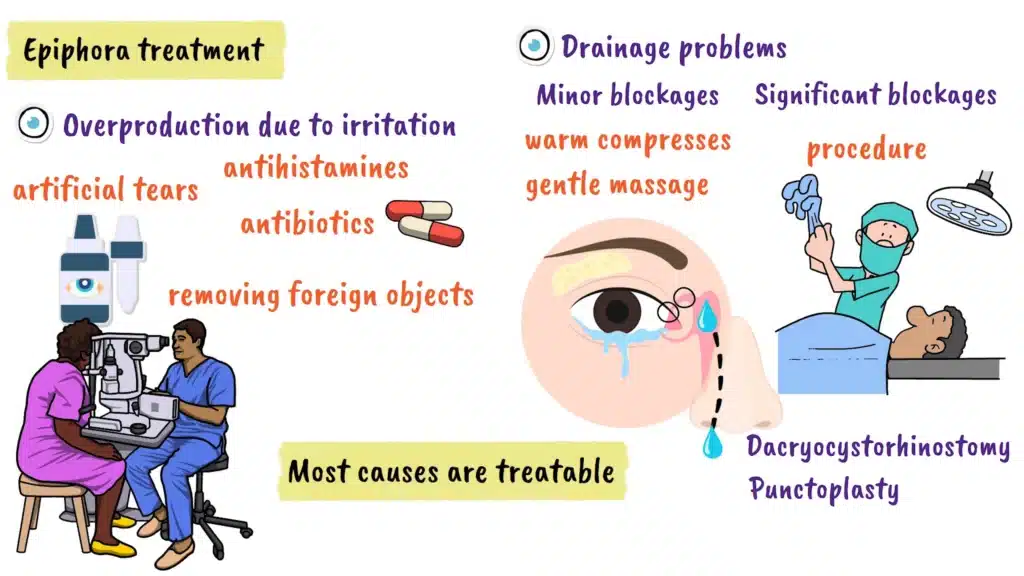
Treatment for epiphora depends entirely on what’s causing it. If the problem is overproduction due to irritation, treating the underlying irritant is key. This might involve using artificial tears for dry eyes, antihistamines for allergies, antibiotics for infections, or removing foreign objects.
For drainage problems, treatment can range from simple to surgical. Minor blockages sometimes respond to warm compresses and gentle massage of the tear sac area. More significant blockages often require procedures to open up the drainage pathways.
The most common surgical procedure for blocked tear ducts is called dacryocystorhinostomy. This procedure creates a new pathway for tears to drain from the lacrimal sac directly into the nose, bypassing the blocked nasolacrimal duct. It can be done through the skin or through the nose using an endoscope.
For problems with the puncta or canaliculi, different procedures might be needed, such as punctoplasty to enlarge narrowed puncta or placement of small tubes to keep drainage pathways open.
When to Seek Help
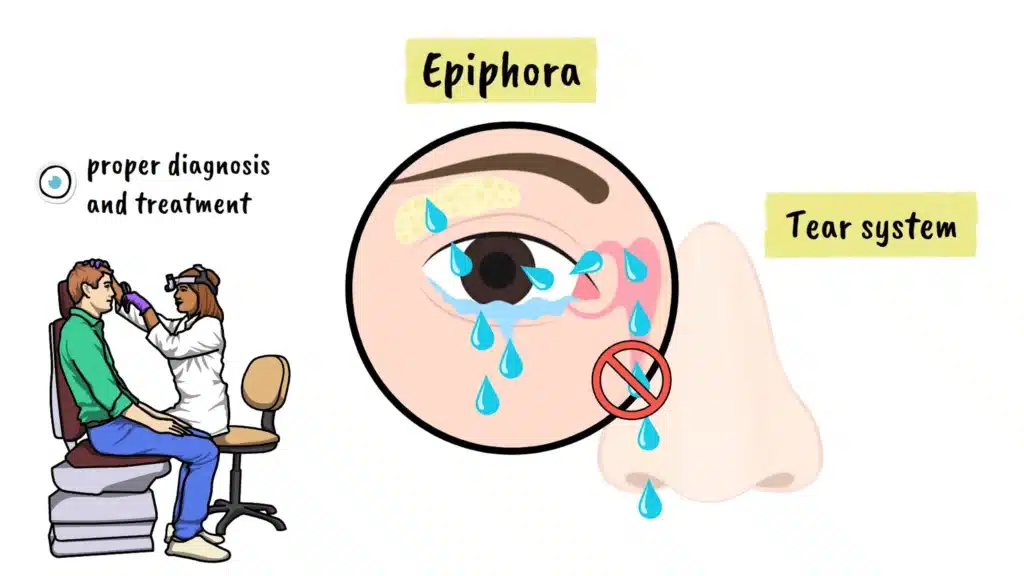
If you’re dealing with watery eyes, it’s important to see an eye care professional for proper evaluation. While epiphora can be bothersome and affect your quality of life, most causes are treatable once properly diagnosed.
Understanding your tear system and what can go wrong with it empowers you to take better care of your eyes and seek appropriate help when needed. While watery eyes might seem like a minor problem, they can significantly impact your daily life and comfort. The good news is that with proper diagnosis and treatment, most people with epiphora can find significant relief and get back to enjoying clear, comfortable vision.
