
A subconjunctival hemorrhage is a broken blood vessel under the clear surface of the eye that creates a bright red patch on the white of the eye. It usually does not affect vision and often clears on its own within 1 to 3 weeks.
For many people, the appearance is the scariest part. The sudden redness can look dramatic, but an isolated subconjunctival hemorrhage is commonly a benign cause of red eye, especially when there is no pain, discharge, or change in vision.
What is Subconjunctival Hemorrhage?
The conjunctiva is the thin, clear tissue that covers the white part of the eye and lines the inside of the eyelids. A subconjunctival hemorrhage happens when a tiny blood vessel in that tissue breaks and blood becomes trapped beneath it.
People often describe it as a “broken blood vessel in the eye” or a “blood spot on the white of the eye.” Those descriptions are accurate in everyday language, even though the blood is actually sitting beneath the conjunctiva rather than inside the eye itself.
One reason this condition causes so much anxiety is that it can appear all at once and look much worse than it feels. Because the blood is not on the cornea or deeper structures of the eye, vision usually stays normal.
Causes and Risk Factors
In many cases, a subconjunctival hemorrhage happens after a small, brief rise in pressure in the veins of the head and neck. Common triggers include coughing hard, sneezing, vomiting, straining during a bowel movement, lifting, pushing, or bending forward.
Minor local trauma is another common cause. Eye rubbing, a fingernail poke, contact lens handling, sports injuries, or other small surface injuries can be enough to break a fragile vessel.
Age matters as well. In younger people, trauma and contact lens use are more frequent contributors, while in older adults, vascular conditions such as high blood pressure, diabetes, and arteriosclerosis are more often associated with these red patches.
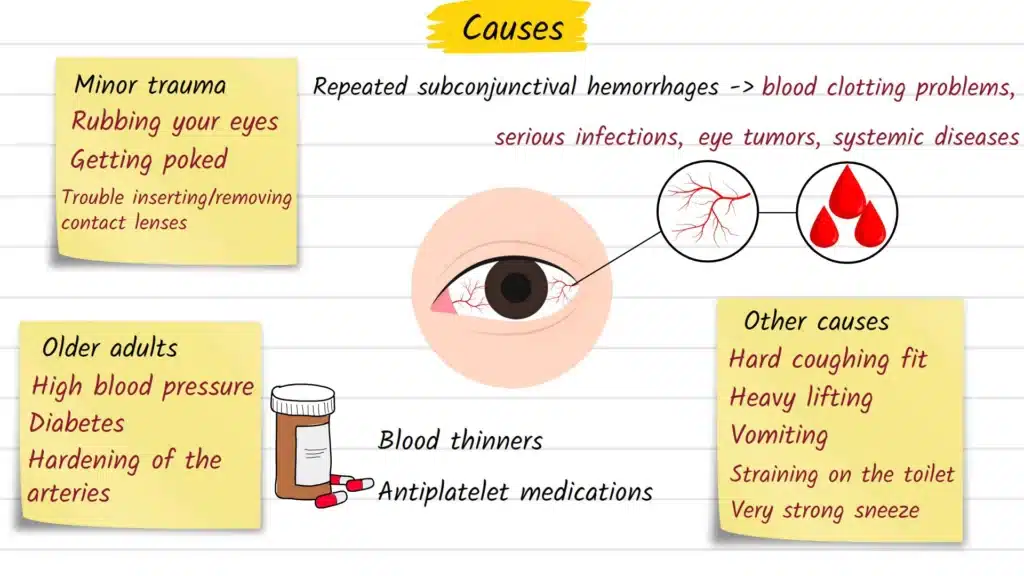
Some medications can make bleeding more likely or make episodes recur more easily. Cleveland Clinic notes that blood thinners are among the medicines linked with subconjunctival hemorrhage, and recurrent cases may prompt review of medications and underlying health conditions.
Sometimes there is no obvious trigger at all. A clinician may call that idiopathic, which simply means the hemorrhage happened without a clearly identifiable cause.
Although most cases are harmless, repeated or persistent subconjunctival hemorrhages deserve more attention. Medical reviews note that recurrent episodes can sometimes be associated with bleeding disorders, systemic disease, medication effects, or, less commonly, ocular surface or conjunctival tumors.
Common Signs and Symptoms
The hallmark sign is a sharply visible red patch on the white of the eye. It may involve a small area or spread across a much larger section of the sclera.
Most people have no pain, no thick discharge, and no change in sight. That is one reason a subconjunctival hemorrhage is different from many eye infections or more serious internal eye problems.
Many people discover it by accident while looking in the mirror or after someone else points it out. A mild scratchy feeling or slight irritation can happen, but significant pain is not typical.
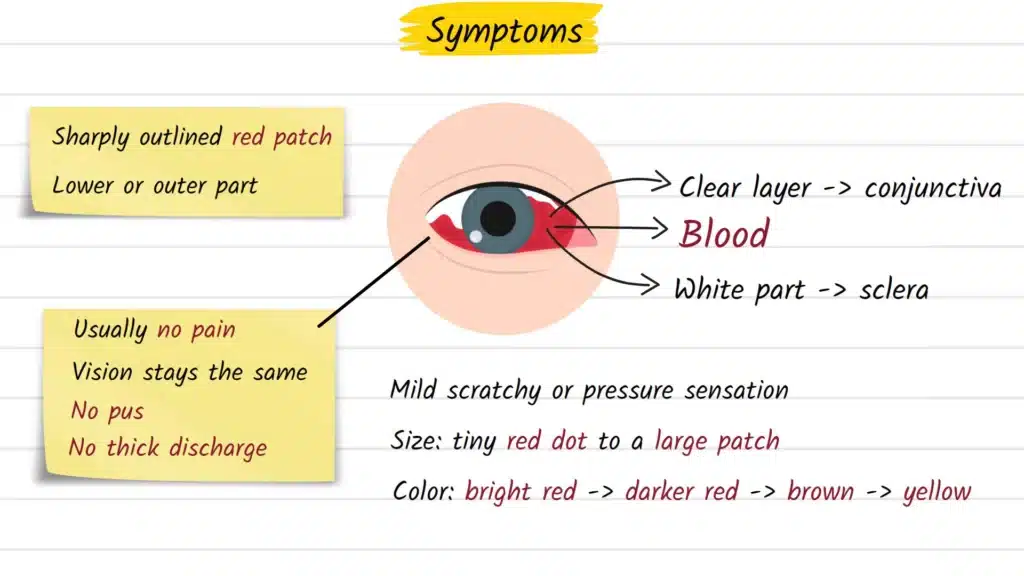
As the trapped blood breaks down, the color may change over time. Cleveland Clinic notes that the area can shift in appearance like a fading bruise as the blood gradually clears.
A useful clue is that the redness does not wipe away. The blood is trapped beneath the conjunctiva, so it stays in place until the body slowly absorbs it.
How the Condition is Diagnosed
A doctor or eye care professional can usually diagnose a subconjunctival hemorrhage by examining the eye and checking vision. In straightforward cases, the appearance is distinctive enough that extensive testing is often unnecessary.
The evaluation becomes more important when the history is not straightforward. Pain, blurred vision, facial injury, swelling, blood inside the eye, or repeated episodes can suggest a different problem or an underlying cause that needs follow-up.
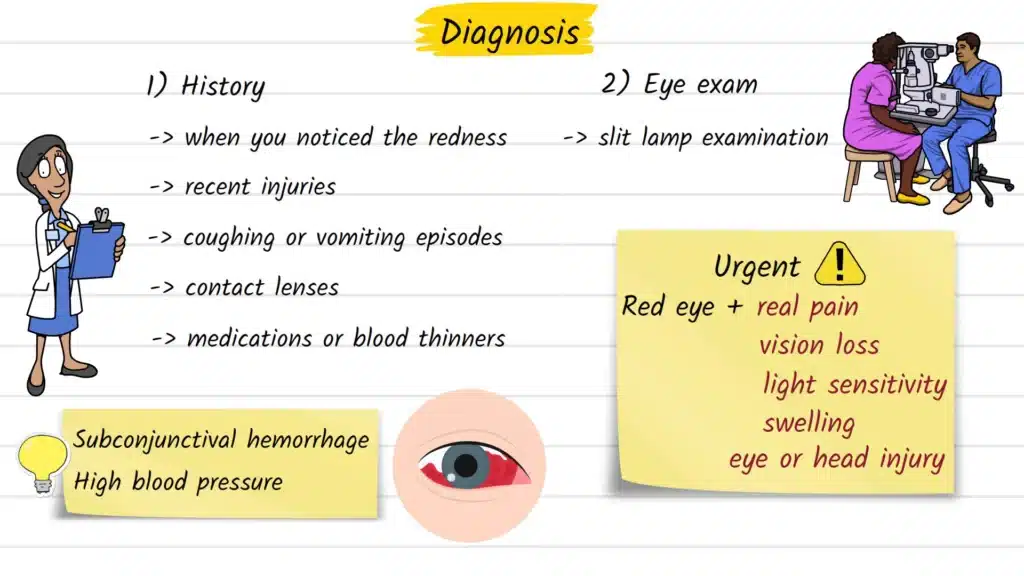
Blood pressure may be checked, especially in adults or in anyone with recurrent episodes, bruising, or bleeding elsewhere. Both Cleveland Clinic and published reviews note that hypertension and bleeding disorders are among the conditions clinicians consider when episodes recur or appear without a clear explanation.
This is also why self-diagnosis has limits. A red eye with pain, light sensitivity, or reduced vision should not automatically be assumed to be a simple subconjunctival hemorrhage.
Treatment Options Explained
For an uncomplicated subconjunctival hemorrhage, the main treatment is usually time. The blood is reabsorbed naturally, and most cases clear without specific therapy.
In general, the redness improves within 1 to 3 weeks. Smaller hemorrhages may resolve sooner, while larger ones can linger longer before fully fading.
Artificial tears may help if the eye feels dry or mildly irritated. They can improve comfort, but they do not remove the blood instantly.
There is no standard eye drop that reliably makes the hemorrhage disappear faster. The MSD and Merck manuals note that treatments such as antibiotics, corticosteroids, vasoconstrictors, and compresses do not speed reabsorption in routine cases.
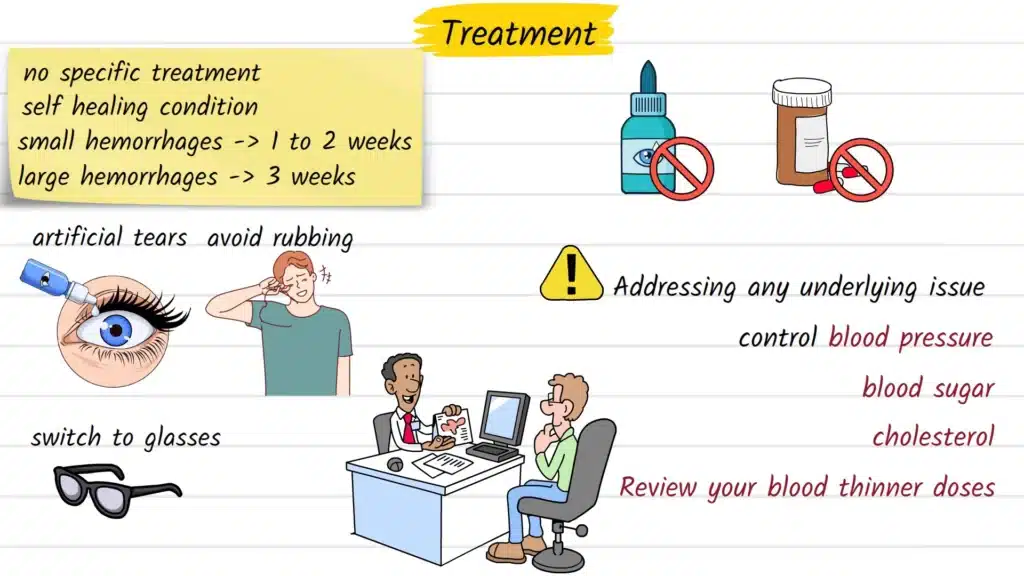
Avoiding additional irritation matters while the eye heals. If the episode followed contact lens handling or eye rubbing, a clinician may advise a short break from lens wear and a return to glasses until the surface is comfortable again.
The more meaningful part of care is sometimes not the eye itself but the bigger picture. When episodes are frequent, persistent, or unexplained, treatment may focus on identifying contributing factors such as high blood pressure, diabetes, medication effects, or a clotting disorder.
Possible Complications if Left Untreated
The hemorrhage itself usually does not damage vision or the eye when it is truly an isolated subconjunctival hemorrhage. In otherwise healthy people, complications are uncommon.
The real concern is missing something behind the redness. Recurrent, persistent, or atypical cases may delay recognition of systemic hypertension, bleeding disorders, significant trauma, or less common ocular conditions if they are ignored.
That is why the phrase “left untreated” needs context here. A one-time blood spot often only needs observation, but repeated events should not be brushed off as cosmetic.
Prevention and Risk Reduction
Not every case can be prevented, especially when there is no clear trigger. Still, some steps may reduce risk in people who are prone to these episodes.
Helpful strategies include:
- Avoid rubbing the eyes aggressively.
- Use contact lenses carefully and keep them clean.
- Wear protective eyewear during sports, work, or activities with eye injury risk.
- Follow up on high blood pressure, diabetes, or bleeding concerns with a healthcare professional.
If you take blood thinners or other medicines linked with easier bleeding, do not stop them on your own. Medication changes should always be reviewed with the prescribing clinician.
When to See an Eye Doctor
A simple subconjunctival hemorrhage often does not require urgent treatment, but some situations do need prompt evaluation. Pain, blurred vision, a swollen eye, blood inside the eye, or a recent eye or facial injury are warning signs that the problem may be more than a surface bleed.
You should also seek medical review if the hemorrhage keeps coming back, does not gradually improve, or occurs along with easy bruising or bleeding in other places. Those patterns can point to an underlying issue that deserves assessment.
A good practical rule is this: if the eye only looks red but feels normal and vision is unchanged, it is more likely to be a routine subconjunctival hemorrhage. If the eye is red and painful, or red and affecting sight, do not assume it is harmless.
Frequently Asked Questions (FAQ)
A broken blood vessel in the eye is often caused by straining, coughing, sneezing, vomiting, lifting, minor trauma, or eye rubbing. In some people, high blood pressure, diabetes, blood thinners, or contact lens use may also play a role.
Most subconjunctival hemorrhages clear on their own within about 1 to 3 weeks. The color may change as it heals, much like a bruise.
It usually does not affect vision. If you notice blurred vision, pain, light sensitivity, or swelling, a different or more serious eye problem should be considered.
Not usually, if the only symptom is a painless red patch and your vision is normal. It becomes more urgent when the redness follows trauma or comes with pain, vision changes, swelling, or blood inside the eye.
High blood pressure is not the only cause, but it is a recognized risk factor, especially in older adults and in recurrent cases. That is one reason clinicians may check blood pressure during the evaluation.
If the episode happened around contact lens wear or the eye feels irritated, many clinicians prefer a short break from lenses until the eye settles. The goal is to avoid additional surface friction while the eye recovers.
