
Today we are covering a condition that affects thousands of people every year, and it starts with something as simple as a blocked drain. We are talking about Dacryocystitis, a medical condition that impacts the eye’s drainage system and can cause significant discomfort if left untreated.
If you are reading this, get ready to understand exactly what Dacryocystitis is, what causes it, why it happens, and most importantly, how to treat it effectively. Whether you are experiencing symptoms yourself or simply want to expand your knowledge about common eye conditions, this comprehensive guide will walk you through everything you need to know about tear duct infections and blockages.
Dacryocystitis might sound like a complicated medical term, but once you understand how your tear drainage system works, the condition becomes much easier to comprehend. The good news is that with proper treatment and understanding, most cases of Dacryocystitis resolve completely without long-term complications.
How Your Tear Drainage System Works
Here is the thing: your eye produces tears constantly throughout the day. These tears do not just sit on your eye and evaporate into thin air. They actually drain out through a sophisticated system that runs from your eye down into your nose. Think of it like a plumbing system in your house. Water from your sink flows through pipes and eventually reaches the sewer. Your tears work in exactly the same way.
Your tear drainage system consists of several key components working together in harmony. Tears begin their journey at the lacrimal gland, located above and to the outer side of your eye. From there, they spread across your eye surface, keeping it moist and protected. Once they have done their job, tears drain through tiny ducts called the superior and inferior puncta, which are small openings located in the corners of your eyelids.
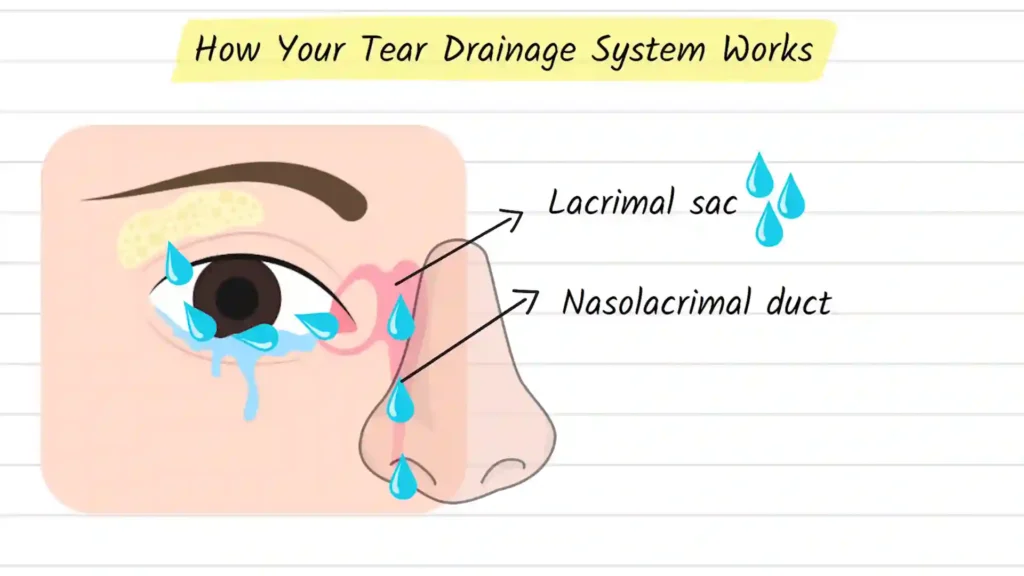
These tears then flow into the lacrimal sac, which serves as the main collection chamber where all those tears hang out before they drain down to your nose. The lacrimal sac is like the hub of your tear drainage system. From the lacrimal sac, tears travel through the nasolacrimal duct, which connects your eye to your nasal cavity. This explains why you get a runny nose when you cry or when your eyes water excessively.
When this entire system works perfectly, you never notice it. Everything flows smoothly, and your tears do their job of lubricating and protecting your eyes without any conscious awareness on your part. But when something blocks that drain anywhere along this pathway, well, that is when things get uncomfortable and problematic. A blockage in any part of this system can lead to tear stagnation, inflammation, and ultimately infection.
What is Dacryocystitis
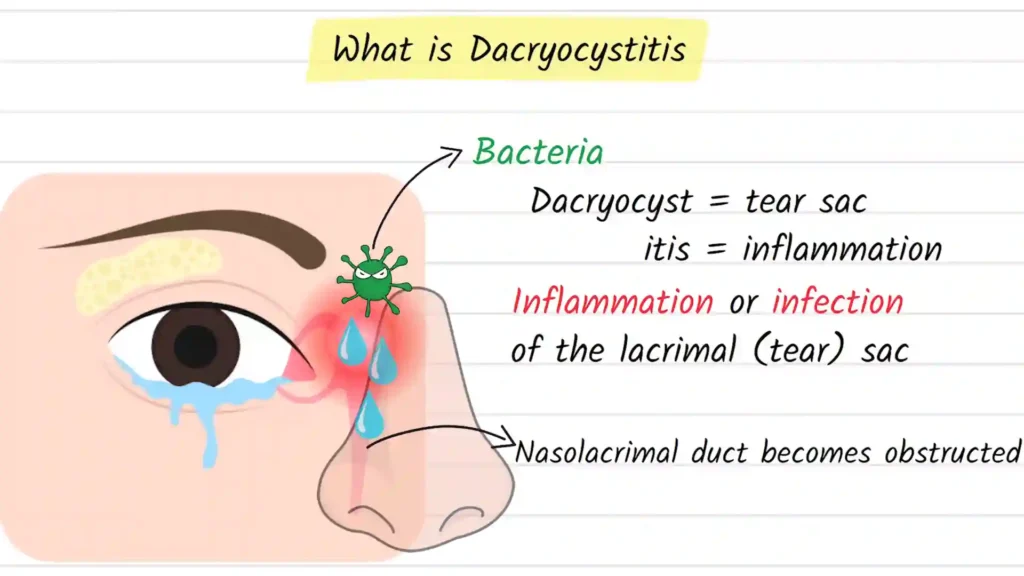
Dacryocystitis is an infection of the tear sac I just mentioned. The medical term breaks down pretty simply: Dacryocyst means tear sac, and itis means inflammation or infection. So we are literally talking about an inflamed, infected tear sac. This happens almost every single time because the nasolacrimal duct becomes obstructed, preventing normal tear drainage.
When your tear duct becomes blocked, the tears that should be draining away instead become trapped in the lacrimal sac. Remember that analogy about your sink? If the pipe gets clogged, water backs up and pools in the sink. The same thing happens with your tears. They back up in the lacrimal sac, and when tears stagnate in there, bacteria move in and establish an infection, creating what we call Dacryocystitis.
Dacryocystitis is more common than many people realize. It affects people of all ages, though it presents differently depending on the individual and the severity of the condition. In some cases, it is a temporary inconvenience that responds well to treatment. In other cases, if left untreated, it can develop into a more serious infection that spreads to surrounding tissues.
The infection typically involves bacteria that are naturally found on the skin and in the environment. Common culprits include Staphylococcus aureus, Streptococcus species, and Haemophilus influenzae. These bacteria are not necessarily dangerous in normal circumstances, but when they find a favorable environment like a blocked tear sac with stagnant tears, they multiply rapidly and cause infection.
Acute vs Chronic Dacryocystitis
Now there are two distinct types of Dacryocystitis: acute and chronic. Understanding the difference between these types is crucial because they present very differently and require different treatment approaches.
Acute Dacryocystitis Explained
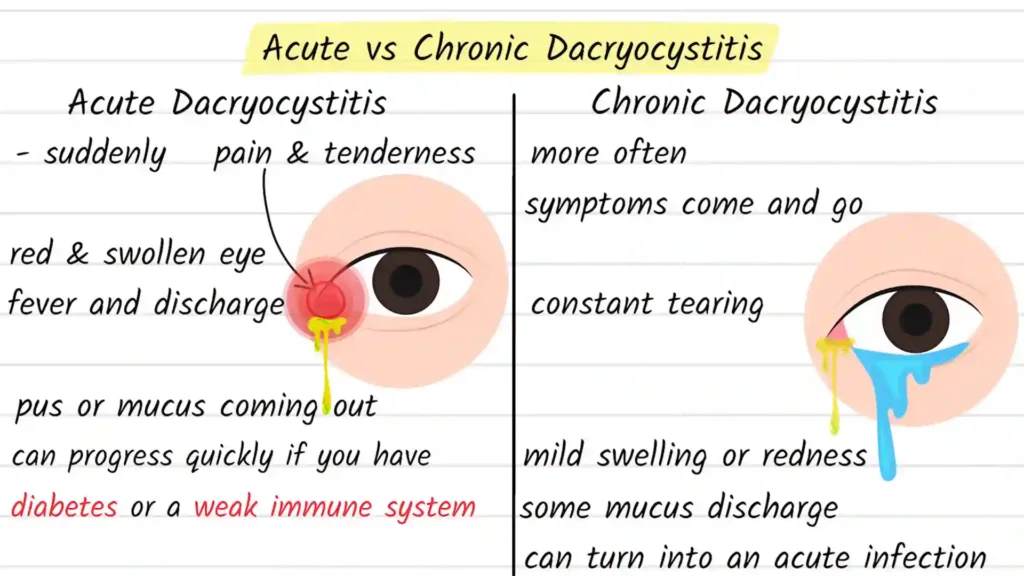
Acute Dacryocystitis comes on suddenly, like a surprise attack on your eye. You might wake up one morning and suddenly feel pain and tenderness right at the inner corner of your eye, near your nose. This area becomes noticeably red and swollen, sometimes so much that you can barely open it or look in a mirror without concern.
With acute Dacryocystitis, you will likely experience several uncomfortable symptoms. Your eye becomes increasingly red and swollen over a short period of time. You might develop a fever as your body fights the infection. There will definitely be discharge coming from your eye, which can range from clear mucus to purulent discharge containing pus. If you gently press on the area over the lacrimal sac, you might even see pus or mucus coming out of the punctum, confirming the infection.
The pain associated with acute Dacryocystitis can be quite significant. The area is tender to the touch, and the swelling can make it difficult to wear contact lenses or perform normal daily activities. Some people describe it as a throbbing sensation in the inner corner of the eye. This is the body’s way of saying something is seriously wrong and needs immediate attention.
Acute Dacryocystitis can progress quickly, especially if you have underlying health conditions like diabetes or a weak immune system. If left untreated, the infection can spread beyond the lacrimal sac to surrounding tissues, potentially leading to orbital cellulitis, which is a serious medical emergency.
Chronic Dacryocystitis Explained
Then there is chronic Dacryocystitis, which is what we see more often in clinical practice. With this version, symptoms come and go over time rather than appearing suddenly. You might notice constant tearing from that eye, even when you are not crying or emotionally affected. Some mild swelling or redness may be present, and there might be some mucus discharge throughout the day.
Chronic Dacryocystitis is not as dramatic as the acute version, but it is definitely annoying, and if you ignore it, it can turn into an acute infection at any time. The constant tearing can interfere with your vision, make it difficult to wear makeup, and cause general discomfort. Over time, the repeated inflammation can damage the lacrimal drainage system further, making the blockage worse.
One challenging aspect of chronic Dacryocystitis is that people often get used to the symptoms and fail to seek treatment, not realizing that surgical intervention might be necessary to fully resolve the problem. The longer the condition persists, the more damage can accumulate in the drainage system.
What Causes Dacryocystitis
What causes the blockage in the first place? There are several reasons this can happen, and understanding the cause is important for determining the best treatment approach.
You could have a facial injury or trauma that damaged the area and resulted in scarring that blocks the duct. Some people have a deviated nasal septum from birth or from an accident, and that anatomical deviation can block the tear drain. Certain medications, especially those used in cancer treatment like 5-fluorouracil and docetaxel, can actually scar the duct and cause it to close up. This is a known side effect that ophthalmologists monitor carefully in cancer patients.
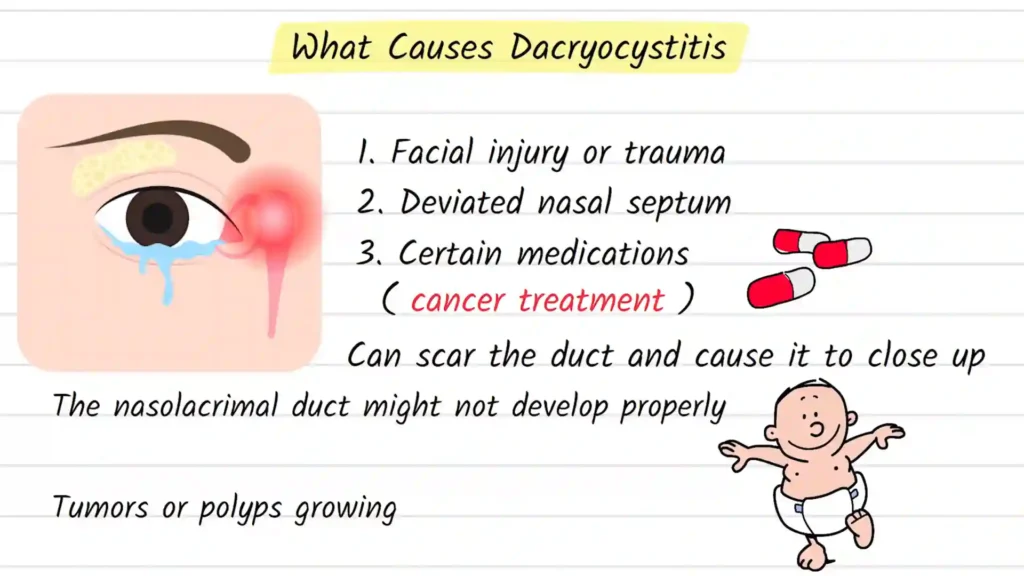
In babies, sometimes the nasolacrimal duct never develops properly or fails to open, which is why newborns sometimes get blocked tear ducts and excessive tearing. Usually this resolves on its own within the first few months of life, but sometimes it requires gentle probing or other interventions.
Sometimes there are tumors or polyps growing in the area that block the flow of tears. These growths can originate in the nasal cavity or sinuses and extend into the nasal passages where the tear duct drains. Additionally, chronic sinusitis or nasal polyps can contribute to tear duct obstruction.
Age-related changes can also play a role. As people get older, the tissues around the lacrimal sac can weaken, and the drainage system can become less efficient. This is why Dacryocystitis is more common in older adults, particularly those over 50 years old.
Treatment for Acute Dacryocystitis
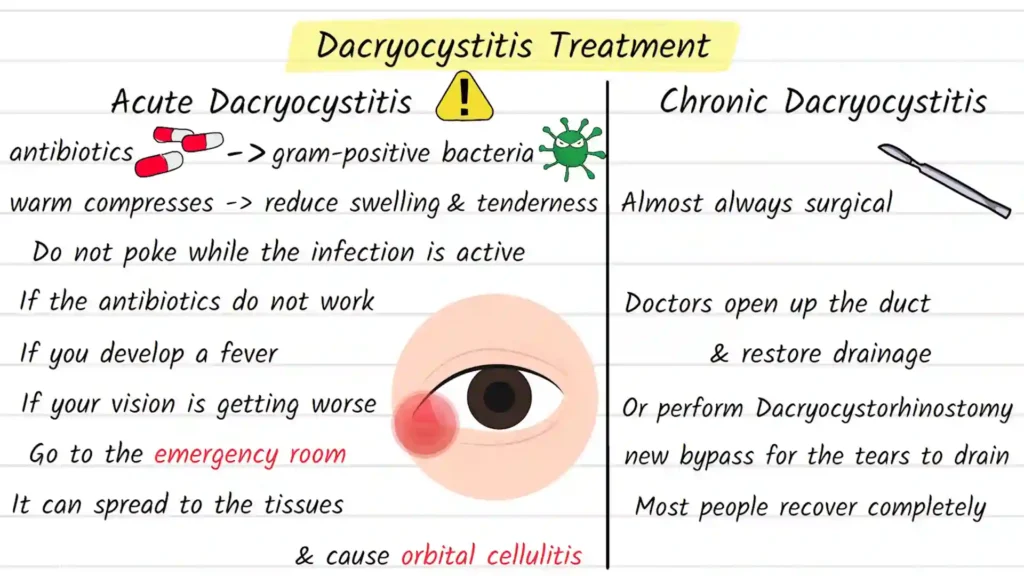
When you have acute Dacryocystitis, the treatment starts immediately. Doctors typically start you on antibiotics that target the most common bacteria causing the infection, usually gram-positive bacteria like staph and streptococcus species. Antibiotic treatment is the cornerstone of acute Dacryocystitis management.
You can apply warm compresses to the affected area to reduce the swelling and tenderness. These warm compresses help increase blood flow to the area and promote drainage. Apply a clean, warm (not hot) compress for 10 to 15 minutes several times daily. There is also something called a Crigler massage that can help move things along by gently expressing the contents of the lacrimal sac, though this should be done carefully and only after the acute infection has begun to resolve.
But here is what you should not do: do not let anyone poke around in there with a probe while the infection is active. That friable tissue, meaning the weakened and inflamed tissue around the sac, can easily tear and create false passages, which makes everything worse. Probing during acute infection can lead to complications that make future treatment more difficult.
Pain management is also important during the acute phase. Over-the-counter pain relievers can help manage discomfort while antibiotics work to clear the infection. Within a few days of starting antibiotics, most people notice significant improvement in their symptoms.
If the antibiotics do not work after a few days, or if you develop a fever, notice your vision getting worse, or see spreading redness and swelling around the eye, you need to go to the emergency room immediately. This can spread to the tissues around your eye and cause orbital cellulitis, which is a serious infection that can threaten your vision and requires hospitalization and aggressive treatment.
Treatment for Chronic Dacryocystitis
For chronic Dacryocystitis, the treatment is almost always surgical because the blockage is not going to resolve on its own. Unlike acute infections that might respond to antibiotics alone, chronic obstruction requires mechanical correction.
Doctors will use a probe to open up the duct and restore drainage, or they might perform a more advanced procedure called a Dacryocystorhinostomy (DCR). In this procedure, surgeons create a new bypass for the tears to drain, essentially creating an alternative pathway around the obstruction. This is typically done when the blockage is at the level of the nasolacrimal duct itself.
The DCR procedure is highly effective, with success rates exceeding 90 percent. It can be performed using an external approach or an endoscopic approach from inside the nose. The endoscopic approach has become increasingly popular because it avoids external scarring and has comparable success rates to the traditional external approach.
The good news is that with treatment, most people recover completely from Dacryocystitis. The recovery time after surgery is typically a few weeks, during which you will need to follow your ophthalmologist’s post-operative care instructions carefully, including using prescribed eye drops and avoiding activities that could put strain on the surgical site.
Conclusion
Dacryocystitis may seem like an intimidating medical condition with a complicated name, but it is a very treatable problem that affects thousands of people every year. Whether you are experiencing acute symptoms or dealing with chronic tearing and discharge, effective treatment options are available.
If you are experiencing symptoms of Dacryocystitis, the most important step is to schedule an appointment with an eye care professional. They can properly diagnose your condition and recommend the appropriate treatment plan for your specific situation. Early intervention typically leads to better outcomes and prevents complications.
If you found this article helpful and you want to learn about more eye conditions and ocular health topics, we encourage you to explore our comprehensive resources on ophthalmology and optometry. We cover everything from common problems like Dacryocystitis to rare diseases and advanced eye conditions. Thank you so much for reading, and we hope this information helps you better understand your eye health.
Sources and References
American Academy of Ophthalmology. Dacryocystitis Overview. https://www.aao.org/
EyeWiki. Dacryocystitis. https://eyewiki.org/Dacryocystitis
College of Optometrists. Clinical Management Guidelines: Dacryocystitis (Acute). https://www.college-optometrists.org/clinical-guidance/clinical-management-guidelines/dacryocystitis_acute
College of Optometrists. Clinical Management Guidelines: Dacryocystitis (Chronic). https://www.college-optometrists.org/clinical-guidance/clinical-management-guidelines/dacryocystitis_chronic
NCBI National Center for Biotechnology Information. Dacryocystitis. https://www.ncbi.nlm.nih.gov/books/NBK470565/
ICR Institute. Dacryocystitis: Lacrimal Sac Inflammation. https://icrcat.com/en/eye-conditions/dacryocystitis/
StatPearls Medical Publishing. Dacryocystitis Review. https://www.ncbi.nlm.nih.gov/books/NBK470565/
