Sign Up

Sign up to Eye Conditions Explained to ask questions, solve cases, and expand your knowledge. Create a profile and connect with eye-care professionals from all over the world. 🌎

Have an account? Sign In
Continue with Google
or use

Captcha Click on image to update the captcha.

Have an account? Sign In Now

Sign In

We want to empower everyone to share their knowledge for the benefit of the entire community. Let people who need your help find you.

Sign Up Here
Continue with Google
or use

Captcha Click on image to update the captcha.

Forgot Password?

Don't have account, Sign Up Here

Forgot Password

Lost your password? Please enter your email address and we will send a new Password at your email. You can change your Password any time from your profile.

Have an account? Sign In Now

Please briefly explain why you feel this question should be reported.

Please briefly explain why you feel this answer should be reported.

Please briefly explain why you feel this user should be reported.

Eye Conditions Explained Logo Eye Conditions Explained Logo
Sign InSign Up

Eye Conditions Explained

Eye Conditions Explained Navigation

Search
Ask A Question

Mobile menu

Close
  • Ask Questions
  • Read Articles
  • Explore Groups
  • View Categories
  • Login
Home/Questions/Page 9

Eye Conditions Explained Latest Questions

Vasilis Inglezis
  • 0
Poll
Vasilis Inglezis
Asked: February 15, 2019In: MCQs

Long-term use of topical steroids may cause:

  • 0

Poll Results

76.67%Glaucoma ( 552 voters )
5.42%Retinitis ( 39 voters )
7.22%Macular degeneration ( 52 voters )
10.69%None of the above ( 77 voters )
Based On 720 Votes

Participate in Poll, Choose Your Answer.

Similar question: Commotio Retinae is the result of:
glaucoma.macular degenerationretinitistopical steroids
2
  • 2
  • 0
Vasilis Inglezis
  • 4
Poll
Vasilis Inglezis
Asked: February 12, 2019In: MCQs

How would you diagnose this based on the image?

  • 4

Poll Results

18.89%Torpedo maculopathy ( 123 voters )
9.06%Retinal coloboma ( 59 voters )
15.51%Myelinated nerve fiber layer ( 101 voters )
56.53%Ocular albinism ( 368 voters )
Based On 651 Votes

Participate in Poll, Choose Your Answer.

How would you diagnose this based on the image?

myelinated nerve fiber layerocular albinismretinal colobomatorpedo maculopathy
0
  • 0
  • 0
Vasilis Inglezis
  • 2
Poll
Vasilis Inglezis
Asked: February 11, 2019In: MCQs

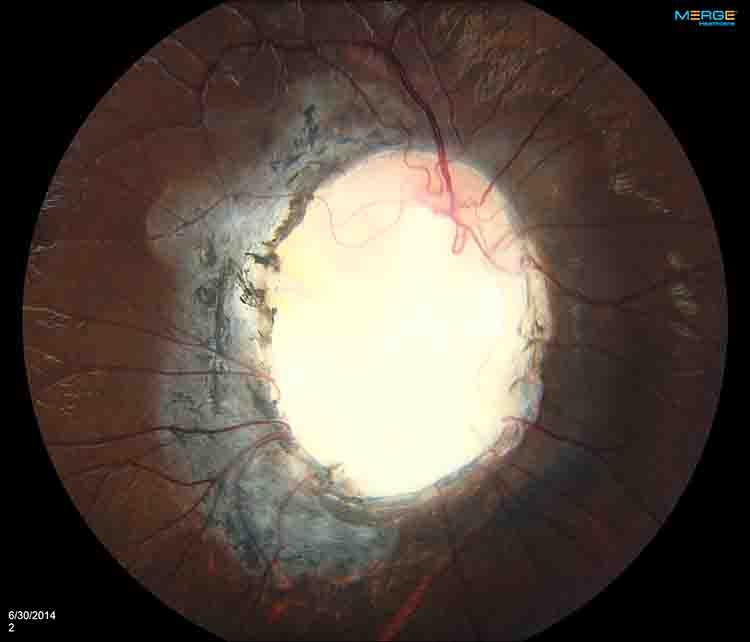
How would you diagnose this based on the image?

  • 2

Poll Results

75.3%Retinal coloboma ( 634 voters )
12.95%Choroideremia ( 109 voters )
6.77%Cone dystrophy ( 57 voters )
4.99%Drusen ( 42 voters )
Based On 842 Votes

Participate in Poll, Choose Your Answer.

How would you diagnose this based on the image?

Similar question: Which one of the following diagnostic tests is NOT useful in evaluating a patient with a retained ...Read more
choroideremiacone dystrophydrusenretinal coloboma
0
  • 0
  • 0
Vasilis Inglezis
  • 0
Poll
Vasilis Inglezis
Asked: February 11, 2019In: MCQs

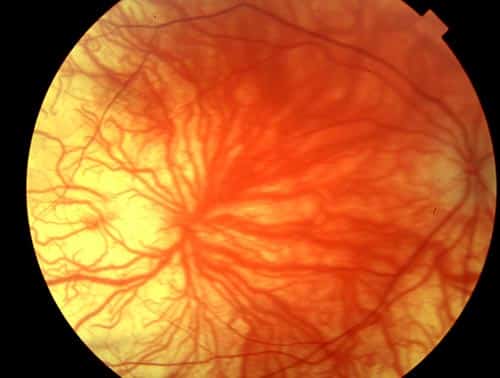
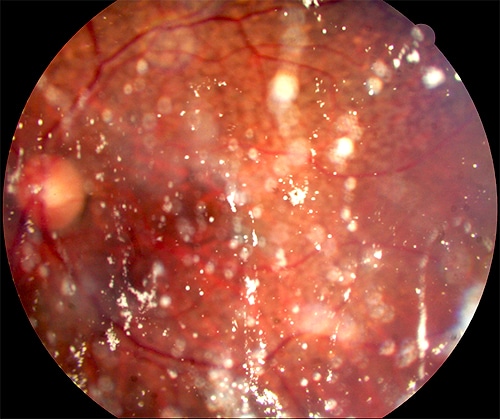
How would you diagnose this based on the image?

  • 0

Poll Results

12.58%Stargardt disease ( 60 voters )
75.89%Papilledema ( 362 voters )
3.56%Vitreous hemorrhage ( 17 voters )
7.97%Asteroid hyalosis ( 38 voters )
Based On 477 Votes

Participate in Poll, Choose Your Answer.

How would you diagnose this based on the image?

1
  • 1
  • 1
Vasilis Inglezis
  • 1
Poll
Vasilis Inglezis
Asked: February 11, 2019In: MCQs

What condition causes leukocoria?

  • 1

Poll Results

84.22%Vitreous haemorrhage ( 571 voters )
6.34%Open angle glaucoma ( 43 voters )
3.24%Retinoblastoma ( 22 voters )
6.19%Malignant melanoma ( 42 voters )
Based On 678 Votes

Participate in Poll, Choose Your Answer.

Similar question: What is the most common cause of vitreous hemorrhage in adults?

leukocoria
2
  • 2
  • 0
Vasilis Inglezis
  • 0
Poll
Vasilis Inglezis
Asked: February 10, 2019In: MCQs

Rubeosis iridis is NOT associated with:

  • 0

Poll Results

44.93%Acute iridocyclitis ( 186 voters )
17.87%Central retinal vein occlusion ( 74 voters )
30.68%Chronic retinal detachment ( 127 voters )
6.52%Ocular ischemic syndrome ( 27 voters )
Based On 414 Votes

Participate in Poll, Choose Your Answer.

Related question: Which one of the following ocular signs is NOT seen in Horner’s syndrome?   Answer: Rubeosis iridis is ...Read more

rubeosis iridis
1
  • 1
  • 0
Vasilis Inglezis
  • 1
Poll
Vasilis Inglezis
Asked: February 8, 2019In: MCQs

Cylindrical lenses are used to correct:

  • 1

Poll Results

2.05%Nearsightedness ( 11 voters )
4.29%Astigmatism ( 23 voters )
93.47%Cataract ( 501 voters )
0.19%Farsightedness ( 1 voter )
Based On 536 Votes

Participate in Poll, Choose Your Answer.

Related question: Which of the following transpositions is the correct one?   Answer: Cylindrical lenses are used to correct Astigmatism. ...Read more

cylindrical lens
0
  • 0
  • 0
Vasilis Inglezis
  • 2
Poll
Vasilis Inglezis
Asked: February 7, 2019In: MCQs

Which of the following diseases is NOT associated with myopia?

  • 2

Poll Results

15.22%Marfan syndrome ( 63 voters )
50.48%Stargardt disease ( 209 voters )
15.7%Stickler syndrome ( 65 voters )
18.6%Wagner disease ( 77 voters )
Based On 414 Votes

Participate in Poll, Choose Your Answer.

Related question: Which of the statement below is correct about Myopia? (justify your answer)   Answer: Stargardt disease is not ...Read more

myopia
0
  • 0
  • 0
Vasilis Inglezis
  • 3
Poll
Vasilis Inglezis
Asked: February 7, 2019In: MCQs

The primary action of the superior oblique muscle is:

  • 3

Poll Results

59.06%intorsion ( 378 voters )
17.5% depression ( 112 voters )
8.59%abduction ( 55 voters )
14.84%elevation ( 95 voters )
Based On 640 Votes

Participate in Poll, Choose Your Answer.

Related question: The actions of inferior oblique muscle are:   Answer: Primary action is intorsion (medial rotation); secondary actions are to ...Read more

extraocular muscle
0
  • 0
  • 0
Vasilis Inglezis
  • 0
Poll
Vasilis Inglezis
Asked: February 6, 2019In: MCQs

Perimetry commonly shows enlarged blind spots in case of:

  • 0

Poll Results

7.95%Usher syndrome ( 49 voters )
70.78%Papilledema ( 436 voters )
6.17%Vitreous hemorrhage ( 38 voters )
15.1%Retinal detachment ( 93 voters )
Based On 616 Votes

Participate in Poll, Choose Your Answer.

Related question: Which of the following statements is NOT true about cones:   Answer: Papilledema

blind spotpapilledemaperimetryretinal detachmentusher syndromevitreous hemorrhage
0
  • 0
  • 0
1 … 8 9 10 … 16

Sidebar

Stats

Recent Posts

  • Central Retinal Vein Occlusion: Symptoms & Treatment

  • Homonymous Hemianopia: Causes, Symptoms & Treatment

  • Iris Freckles: Causes, Diagnosis & When to See a Doctor

  • Papilledema: Optic Disc Swelling From High ICP

  • Iritis (Anterior Uveitis): Symptoms, Causes & Treatment

Top Groups

  • Eye Conditions MCQ Discussion Group
    • Public group

    Eye Conditions MCQ Discussion Group

Explore

  • Ask Questions
  • Read Articles
  • Explore Groups
  • View Categories
  • Login

© 2018-2026 Eye Conditions Explained. All Rights Reserved
Terms of Use.