Sign Up

Sign up to Eye Conditions Explained to ask questions, solve cases, and expand your knowledge. Create a profile and connect with eye-care professionals from all over the world. 🌎

Have an account? Sign In
Continue with Google
or use

Captcha Click on image to update the captcha.

Have an account? Sign In Now

Sign In

We want to empower everyone to share their knowledge for the benefit of the entire community. Let people who need your help find you.

Sign Up Here
Continue with Google
or use

Captcha Click on image to update the captcha.

Forgot Password?

Don't have account, Sign Up Here

Forgot Password

Lost your password? Please enter your email address and we will send a new Password at your email. You can change your Password any time from your profile.

Have an account? Sign In Now

Please briefly explain why you feel this question should be reported.

Please briefly explain why you feel this answer should be reported.

Please briefly explain why you feel this user should be reported.

Eye Conditions Explained Logo Eye Conditions Explained Logo
Sign InSign Up

Eye Conditions Explained

Eye Conditions Explained Navigation

Search
Ask A Question

Mobile menu

Close
  • Ask Questions
  • Read Articles
  • Explore Groups
  • View Categories
  • Login
What's your question?
  • Recent Questions
  • Most Answered
  • No Answers
  • Answers
  • Most Visited
  • Most Voted
Vasilis Inglezis
  • 2
Poll
Vasilis Inglezis
Asked: December 31, 2018In: MCQs

How much dioptric power does the cornea have?

  • 2

Poll Results

73.11%More than the lens ( 435 voters )
21.68%Less power than the lens ( 129 voters )
1.01%Same power to the lens ( 6 voters )
4.2%It changes comparing to the lens ( 25 voters )
Based On 595 Votes

Participate in Poll, Choose Your Answer.
corneadioptric powerlens
2
  • 2
  • 0
Vasilis Inglezis
  • 0
Poll
Vasilis Inglezis
Asked: March 5, 2019In: MCQs

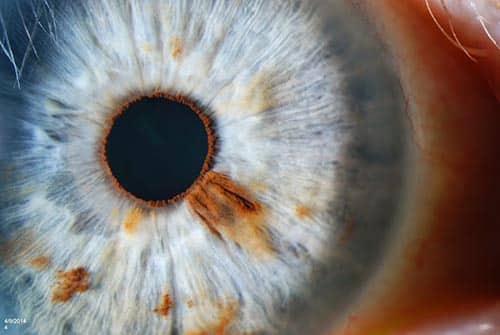
How would you diagnose this based on the image?

  • 0

Poll Results

1.52%Conjunctival nevus ( 8 voters )
87.26%Iris nevus ( 459 voters )
1.9%Choroidal nevus ( 10 voters )
9.32%None of the above ( 49 voters )
Based On 526 Votes

Participate in Poll, Choose Your Answer.

How would you diagnose this based on the image?

Similar question: Which one of the following ocular signs is NOT seen in Horner’s syndrome?

choroidal nevusconjunctival nevusiris nevus
0
  • 0
  • 0
Vasilis Inglezis
  • 0
Poll
Vasilis Inglezis
Asked: January 31, 2019In: MCQs

Eyelid function includes:

  • 0

Poll Results

1.14%keep the eyes from drying out when asleep ( 6 voters )
3.42%blink reflex protects the eye from foreign bodies ( 18 voters )
2.09%spread the tears on the eye surface to keep it moist ( 11 voters )
93.35%All of the above ( 491 voters )
Based On 526 Votes

Participate in Poll, Choose Your Answer.

Related question: Lagophthalmos can arise from a malfunction of the: Answer: Its key function is to regularly spread the tears ...Read more

eyelid
1
  • 1
  • 0
Vasilis Inglezis
  • 0
Poll
Vasilis Inglezis
Asked: March 3, 2019In: MCQs

Which is NOT a layer of the iris:

  • 0

Poll Results

2.82%Anterior pigment epithelium ( 24 voters )
11.87%Myopeithelium ( 101 voters )
5.29%Anterior limiting layer ( 45 voters )
80.02%Descemet's membrane ( 681 voters )
Based On 851 Votes

Participate in Poll, Choose Your Answer.

Similar question: Which of the following layers does NOT belong to sclera?

anterior limiting layeranterior pigment epitheliumdescemet's membraneirismyopeithelium
1
  • 1
  • 0
Admin
  • 3
Poll
Admin
Asked: March 3, 2019In: MCQs

In Familial dysautonomia (Riley–Day syndrome), vision loss is often due to:

  • 3

Poll Results

24%Corneal abrasion ( 48 voters )
39.5%Glaucoma ( 79 voters )
19.5%Congenital cataract ( 39 voters )
17%None of the above ( 34 voters )
Based On 200 Votes

Participate in Poll, Choose Your Answer.
Question: Can you name that disease based on the image?

congenital cataractcorneal abrasionglaucoma.
0
  • 0
  • 1
Vasilis Inglezis
  • 0
Poll
Vasilis Inglezis
Asked: March 2, 2019In: MCQs

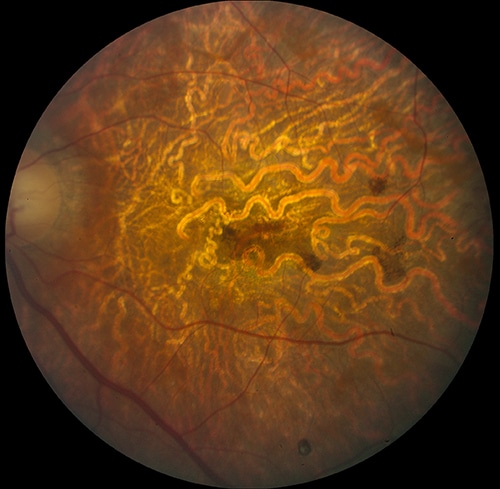
What’s your diagnosis based on the image?

  • 0

Poll Results

26.23%Retinitis pigmentosa ( 192 voters )
13.52%Best Disease ( 99 voters )
27.19%Stargardt disease ( 199 voters )
33.06%None of the above ( 242 voters )
Based On 732 Votes

Participate in Poll, Choose Your Answer.
What’s your diagnosis based on the image?

Similar question: How would you diagnose this based on the image?

best diseaseretinitis pigmentosastargardt disease
0
  • 0
  • 0
Vasilis Inglezis
  • 1
Poll
Vasilis Inglezis
Asked: March 2, 2019In: MCQs

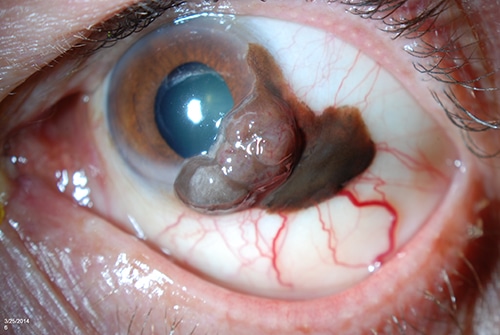
How would you diagnose this based on the image?

  • 1

Poll Results

3.92%Band keratopathy ( 37 voters )
90.35%Conjunctival melanoma ( 852 voters )
2.12%Endophthalmitis ( 20 voters )
3.61%Intraocular foreign body ( 34 voters )
Based On 943 Votes

Participate in Poll, Choose Your Answer.

How would you diagnose this based on the image?

Similar question: How would you diagnose this based on the image?

band keratopathyconjunctival melanomaendophthalmitisintraocular foreign body
0
  • 0
  • 0

Sidebar

Stats

Recent Posts

  • Central Retinal Vein Occlusion: Symptoms & Treatment

  • Homonymous Hemianopia: Causes, Symptoms & Treatment

  • Iris Freckles: Causes, Diagnosis & When to See a Doctor

  • Papilledema: Optic Disc Swelling From High ICP

  • Iritis (Anterior Uveitis): Symptoms, Causes & Treatment

Top Groups

  • Eye Conditions MCQ Discussion Group
    • Public group

    Eye Conditions MCQ Discussion Group

Explore

  • Ask Questions
  • Read Articles
  • Explore Groups
  • View Categories
  • Login

© 2018-2026 Eye Conditions Explained. All Rights Reserved
Terms of Use.