Sign Up

Sign up to Eye Conditions Explained to ask questions, solve cases, and expand your knowledge. Create a profile and connect with eye-care professionals from all over the world. 🌎

Have an account? Sign In
Continue with Google
or use

Captcha Click on image to update the captcha.

Have an account? Sign In Now

Sign In

We want to empower everyone to share their knowledge for the benefit of the entire community. Let people who need your help find you.

Sign Up Here
Continue with Google
or use

Captcha Click on image to update the captcha.

Forgot Password?

Don't have account, Sign Up Here

Forgot Password

Lost your password? Please enter your email address and we will send a new Password at your email. You can change your Password any time from your profile.

Have an account? Sign In Now

Please briefly explain why you feel this question should be reported.

Please briefly explain why you feel this answer should be reported.

Please briefly explain why you feel this user should be reported.

Eye Conditions Explained Logo Eye Conditions Explained Logo
Sign InSign Up

Eye Conditions Explained

Eye Conditions Explained Navigation

Search
Ask A Question

Mobile menu

Close
  • Ask Questions
  • Read Articles
  • Explore Groups
  • View Categories
  • Login
What's your question?
  • Recent Questions
  • Most Answered
  • No Answers
  • Answers
  • Most Visited
  • Most Voted

Eye Conditions Explained Latest Questions

Vasilis Inglezis
  • 1
Poll
Vasilis Inglezis
Asked: May 5, 2019In: MCQs

5th nerve palsy (trigeminal nerve) can cause:

  • 1

Poll Results

49.72%Neurotrophic keratopathy ( 352 voters )
28.95%Ptosis ( 205 voters )
6.92%Proptosis ( 49 voters )
14.41%None of the above ( 102 voters )
Based On 708 Votes

Participate in Poll, Choose Your Answer.

Suggested question: Paralytic ptosis of the eyelid is due to:

nerve palsy
0
  • 0
  • 0
Vasilis Inglezis
  • 0
Poll
Vasilis Inglezis
Asked: January 30, 2019In: MCQs

Distichiasis is a condition in which

  • 0

Poll Results

18.5%eyelashes are curved inward toward the cornea ( 123 voters )
78.95%an extra row of eyelashes emerges from the ducts of meibomian glands ( 525 voters )
1.65%the lower eyelid turns outwards ( 11 voters )
0.9% an oil gland in the eyelid is infected ( 6 voters )
Based On 665 Votes

Participate in Poll, Choose Your Answer.

Related question:  Eyelid function includes: Answer: Distichiasis is a condition in which an extra row of eyelashes emerges from the ducts ...Read more

distichiasis
0
  • 0
  • 0
Vasilis Inglezis
  • 1
Poll
Vasilis Inglezis
Asked: February 23, 2019In: MCQs

Paralytic ptosis of the eyelid is due to:

  • 1

Poll Results

6.23%Complete or partial 4th nerve palsy ( 40 voters )
71.18%Complete or partial 3rd nerve palsy ( 457 voters )
16.2%Complete or partial 7th nerve palsy ( 104 voters )
6.39%Complete or partial 6th nerve palsy ( 41 voters )
Based On 642 Votes

Participate in Poll, Choose Your Answer.

Similar question: Which is the direction of the eye in oculomotor nerve palsy?

eyelid
3
  • 3
  • 0
Vasilis Inglezis
  • 0
Poll
Vasilis Inglezis
Asked: February 15, 2019In: MCQs

Long-term use of topical steroids may cause:

  • 0

Poll Results

76.67%Glaucoma ( 552 voters )
5.42%Retinitis ( 39 voters )
7.22%Macular degeneration ( 52 voters )
10.69%None of the above ( 77 voters )
Based On 720 Votes

Participate in Poll, Choose Your Answer.

Similar question: Commotio Retinae is the result of:

glaucoma.macular degenerationretinitistopical steroids
2
  • 2
  • 0
Vasilis Inglezis
  • 0
Poll
Vasilis Inglezis
Asked: January 30, 2019In: MCQs

Lagophthalmos can arise from a malfunction of the:

  • 0

Poll Results

2.38%Optic nerve (II) ( 15 voters )
42.63%Oculomotor (III) ( 269 voters )
53.72%Facial nerve (VII) ( 339 voters )
1.27%Hypoglossal (XII) ( 8 voters )
Based On 631 Votes

Participate in Poll, Choose Your Answer.

Answer: Lagophthalmos is the condition in which the patient cannot close the eyelids completely and it arises from a malfunction ...Read more
lagophthalmos
0
  • 0
  • 0
Vasilis Inglezis
  • 4
Poll
Vasilis Inglezis
Asked: February 12, 2019In: MCQs

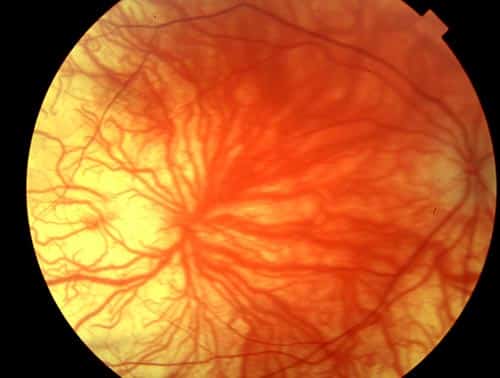
How would you diagnose this based on the image?

  • 4

Poll Results

18.89%Torpedo maculopathy ( 123 voters )
9.06%Retinal coloboma ( 59 voters )
15.51%Myelinated nerve fiber layer ( 101 voters )
56.53%Ocular albinism ( 368 voters )
Based On 651 Votes

Participate in Poll, Choose Your Answer.

How would you diagnose this based on the image?

myelinated nerve fiber layerocular albinismretinal colobomatorpedo maculopathy
0
  • 0
  • 0
Vasilis Inglezis
  • 0
Poll
Vasilis Inglezis
Asked: April 22, 2019In: MCQs

Corneal sensitivity is reduced in:

  • 0

Poll Results

16.21%Keratoconus ( 101 voters )
12.68%Corneal Ulcer ( 79 voters )
32.58%Herpes Simplex Virus Keratitis ( 203 voters )
38.52%All of the above ( 240 voters )
Based On 623 Votes

Participate in Poll, Choose Your Answer.

Suggested question: Process of measuring the corneal thickness is called:

corneal ulcerherpes simplex virus keratitiskeratoconus
1
  • 1
  • 0

Sidebar

Stats

Recent Posts

  • Central Retinal Vein Occlusion: Symptoms & Treatment

  • Homonymous Hemianopia: Causes, Symptoms & Treatment

  • Iris Freckles: Causes, Diagnosis & When to See a Doctor

  • Papilledema: Optic Disc Swelling From High ICP

  • Iritis (Anterior Uveitis): Symptoms, Causes & Treatment

Top Groups

  • Eye Conditions MCQ Discussion Group
    • Public group

    Eye Conditions MCQ Discussion Group

Explore

  • Ask Questions
  • Read Articles
  • Explore Groups
  • View Categories
  • Login

© 2018-2026 Eye Conditions Explained. All Rights Reserved
Terms of Use.