
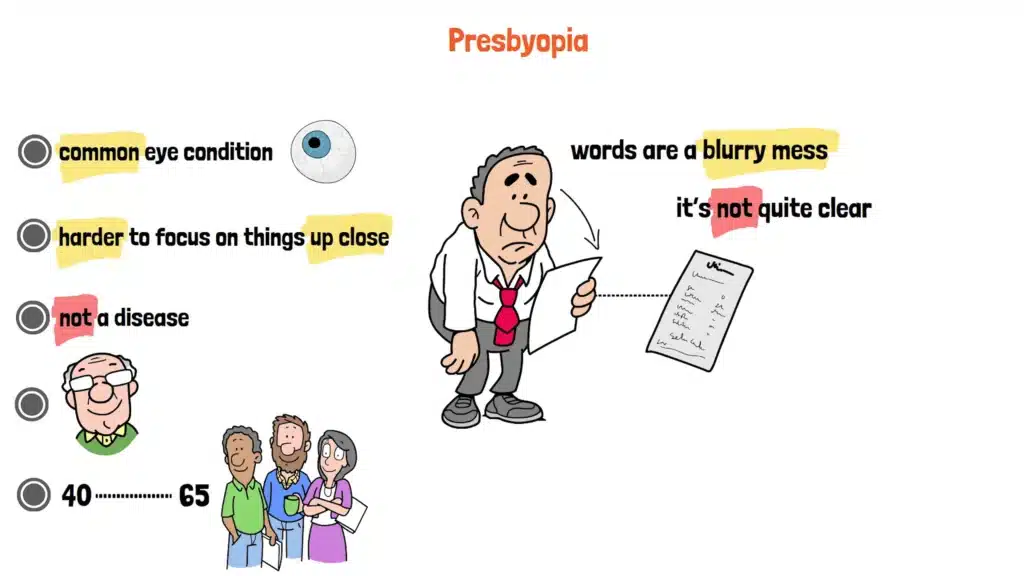
Picture this: you’re trying to read the fine print on a label, but the words are a blurry mess. You hold it farther away, squint a little, and still, it’s not quite clear. Sound familiar? That’s presbyopia at work. Presbyopia is a common eye condition that makes it harder to focus on things up close as you age. It’s not a disease, just a natural part of getting older, and it typically starts creeping in around your early 40s. By age 65, nearly everyone feels its effects to some degree.
Why does this matter? Well, presbyopia can make everyday tasks like reading, texting, or even checking your watch frustrating. But here’s the good news: it’s manageable with the right tools and knowledge. Understanding presbyopia empowers you to take action early and maintain your quality of life. This comprehensive guide walks you through what causes presbyopia, who’s at risk, the symptoms to watch for, how it’s diagnosed, treatment options, and ways to manage it. We’ll also explore how it impacts daily life and peek into exciting research that might change how we handle it in the future.
Understanding the Causes of Presbyopia
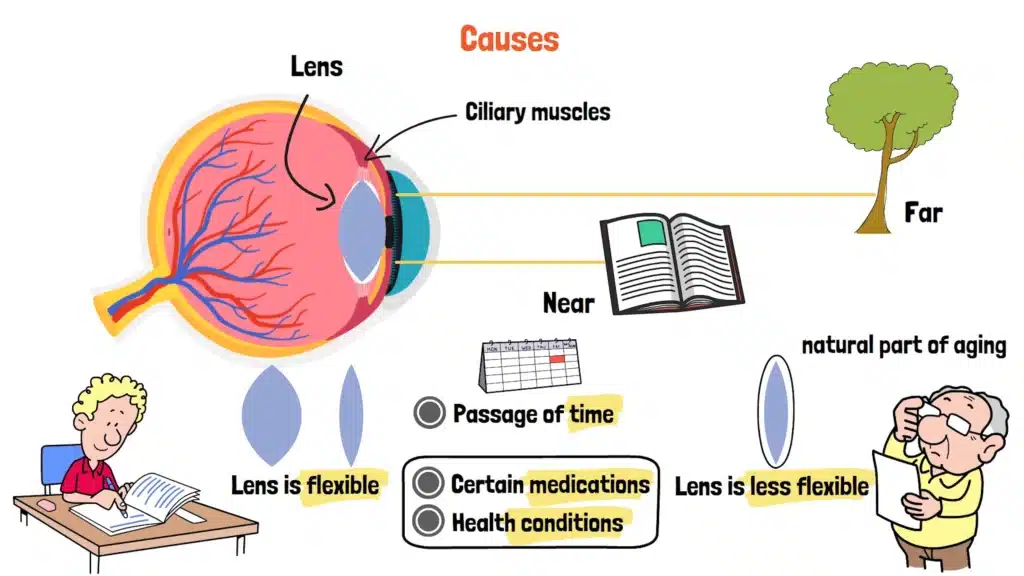
So, what’s behind presbyopia? It all comes down to the lens in your eye. Think of it like a camera lens that zooms in and out to focus on objects near or far. When you’re young, this lens is flexible, bending easily to sharpen your view of a book or a distant sign. But as you age, that lens starts to stiffen, like a rubber band that’s lost its stretch. By your 40s, it can’t change shape as well, making it tough to focus on close-up objects.
This hardening of the lens is the main culprit, and it’s a natural part of aging. The tiny muscles around the lens, called ciliary muscles, also lose some of their strength over time, adding to the problem. There aren’t many other causes: it’s mostly just the passage of time. However, some factors, like certain medications or health conditions, can make presbyopia show up earlier than usual. Understanding these underlying mechanisms helps you appreciate why this condition is so common and why early detection matters.
Risk Factors for Presbyopia: Who Is Most Vulnerable?
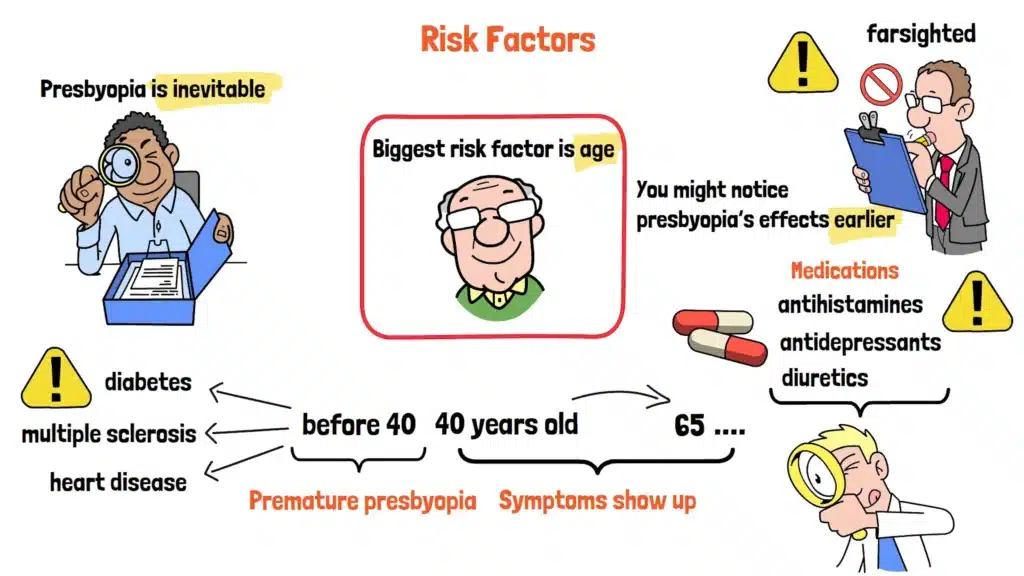
Presbyopia is practically inevitable if you live long enough, but some things can make it show up sooner or feel more intense. The biggest risk factor is age: most people notice symptoms starting around age 40, with effects worsening until about 65. As of 2015, about 25% of the global population, or 1.8 billion people, were dealing with presbyopia, and that number’s likely grown as populations age.
Some folks experience “premature presbyopia” before 40. Certain medical conditions, like diabetes, multiple sclerosis, or heart disease, can increase this risk. If you’re farsighted (meaning you already struggle to see things up close), you might notice presbyopia’s effects earlier. Medications like antihistamines, antidepressants, or diuretics can also interfere with your eye’s focusing ability, potentially speeding things up. While you can’t stop aging, being aware of these factors can help you catch presbyopia early and manage it better.
Recognizing Presbyopia Symptoms
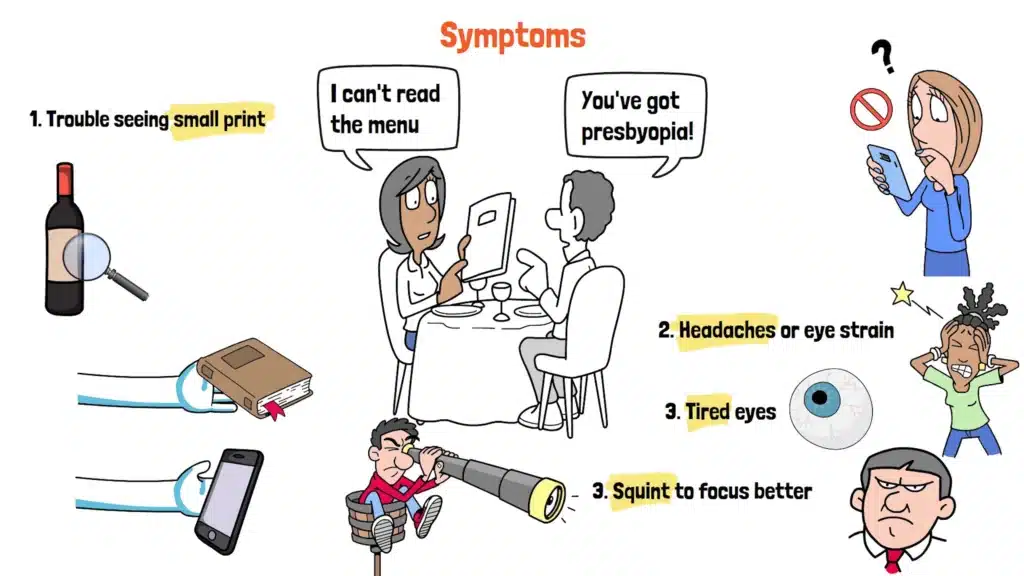
Ever tried reading a menu in a dimly lit restaurant and found yourself stretching your arms out to make the words clear? That’s a classic sign of presbyopia. The first symptom most people notice is trouble seeing small print, especially in low light. You might need to hold books, phones, or labels farther away to read them. As presbyopia progresses, even arm’s length might not cut it.
Other signs include headaches or eye strain after close-up tasks like reading or sewing. Your eyes might feel tired, or you might squint to focus better. In advanced stages, these symptoms can become more persistent, making daily activities frustrating. Common presbyopia symptoms to watch for include difficulty with digital screens, problems with restaurant menus, and challenges with fine detail work. If you’re noticing these changes, don’t panic: it’s a normal part of aging, but it’s worth checking with an eye doctor to confirm and explore solutions.
How Presbyopia Is Diagnosed
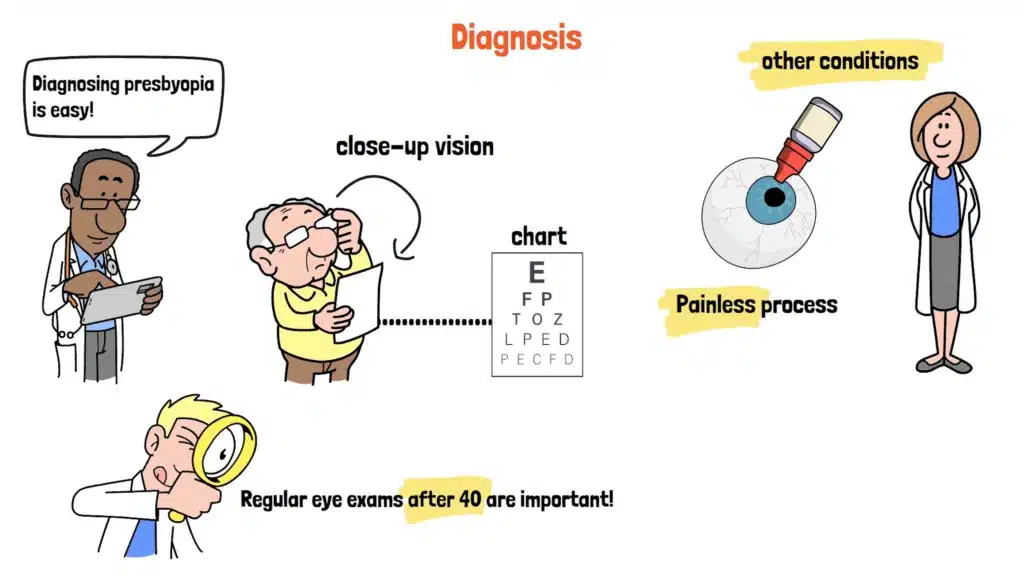
Diagnosing presbyopia is usually a breeze during a routine eye exam. Your eye doctor will start by asking about any trouble you’re having with close-up vision. They’ll likely have you read letters on a chart, both far away and up close, to test your visual acuity. It’s like a quick snapshot of how well your eyes are performing.
A refraction test helps pinpoint the exact lens strength you need for glasses or contacts. The doctor might also dilate your pupils with drops to get a better look inside your eye, checking for other conditions that could affect your vision. This process is painless, though the dilation might make things blurry for a few hours. Regular eye exams, especially after 40, are key to catching presbyopia early, often before you notice major symptoms. Early diagnosis allows you to address presbyopia proactively rather than reactively.
Presbyopia Treatment Options: Finding What Works for You
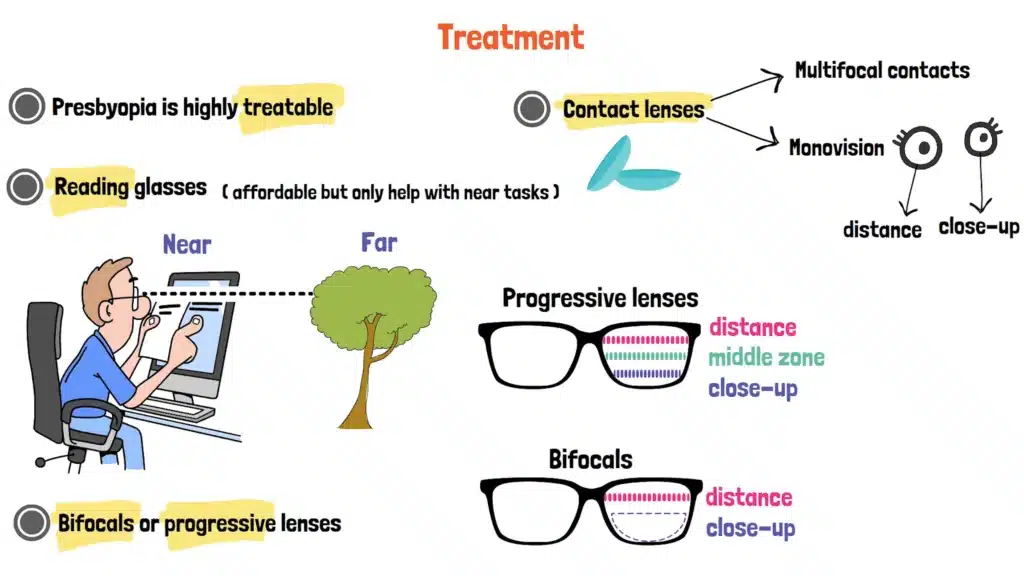
The good news? Presbyopia is highly treatable, with options to fit different lifestyles and needs.
Reading Glasses
The simplest fix is reading glasses, which magnify close-up objects. You can grab a pair over the counter or get a custom prescription for sharper vision. They’re affordable but only help with near tasks. Many people find reading glasses convenient and accessible.
Bifocals and Progressive Lenses
If you need correction for both near and far vision, bifocals or progressive lenses might be the answer. Bifocals have two sections: one for distance, one for close-up, with a visible line between them. Progressive lenses do the same but with a smooth, no-line transition, great for a seamless look. Trifocals add a middle zone for intermediate distances, like computer screens.
Contact Lenses
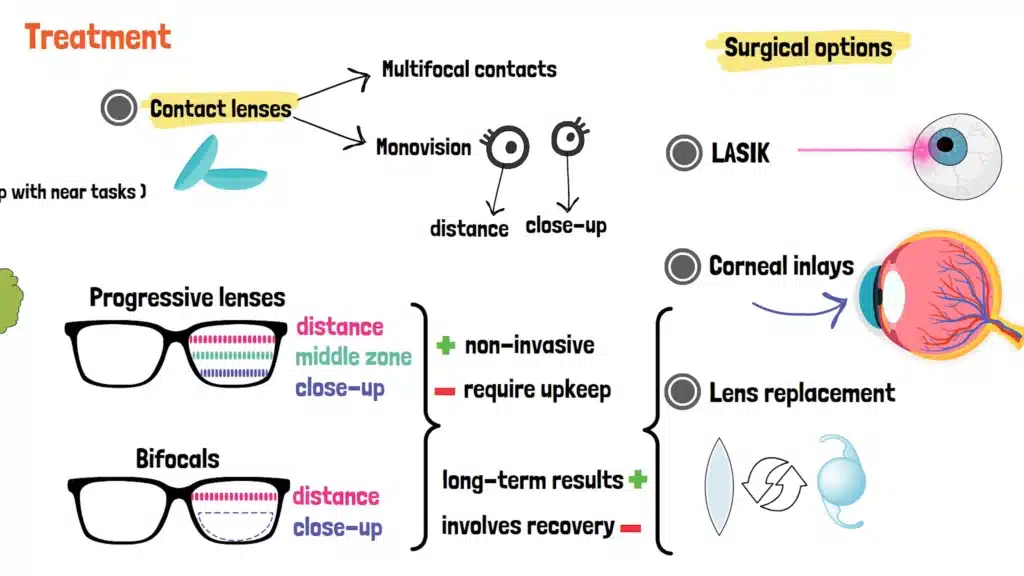
Contact lenses are another option worth exploring. Multifocal contacts blend near and far vision, while monovision corrects one eye for distance and the other for close-up. Monovision can take some getting used to, as it might affect depth perception.
Pilocarpine Eye Drops
A newer treatment involves pilocarpine eye drops, approved by the FDA in 2021. These drops shrink your pupil to improve near vision for up to six hours, though they may cause headaches or red eyes. This pharmaceutical approach offers a non-invasive daily option for presbyopia management.
Surgical Solutions
For a more permanent fix, surgical options exist. LASIK can create monovision, similar to contact lenses. Corneal inlays, tiny devices implanted in the cornea, enhance near vision. Lens replacement surgery swaps your natural lens for an artificial one that focuses at multiple distances. Each option has trade-offs: glasses are non-invasive but require upkeep, while surgery offers long-term results but involves recovery. Talk to your eye doctor to find what suits you best.
Managing Presbyopia: Prevention and Daily Strategies
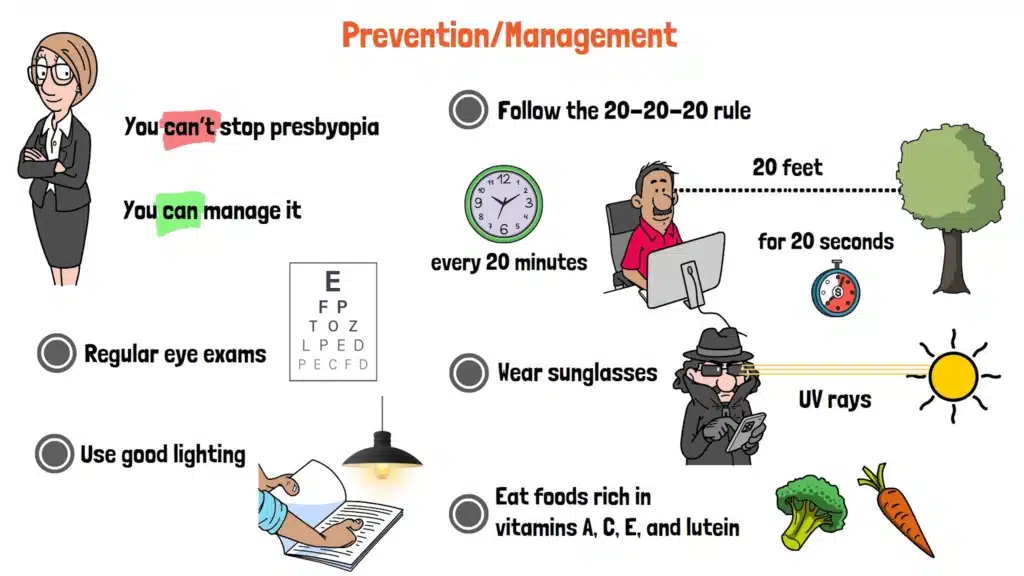
You can’t stop presbyopia: it’s part of aging. But you can manage it effectively and protect your overall eye health. Regular eye exams are crucial, especially after 40, to keep your prescription up to date as presbyopia progresses. A 2021 study noted that uncorrected presbyopia affects quality of life, so staying proactive is key.
To ease symptoms, use good lighting when reading or working. Follow the 20-20-20 rule for screen time: every 20 minutes, look 20 feet away for 20 seconds to rest your eyes. Wear sunglasses to shield your eyes from UV rays, which can harm eye health over time. Eating foods rich in vitamins A, C, E, and lutein, like leafy greens or carrots, supports your eyes, too. While these steps won’t prevent presbyopia, they help keep your eyes in top shape.
Presbyopia’s Impact on Daily Life
Presbyopia can turn simple tasks into challenges. Reading a book, checking your phone, or threading a needle might leave you squinting or frustrated. At work, you could struggle with small text on a computer screen, leading to eye strain or headaches. Hobbies like crafting or cooking, which rely on seeing fine details, can become less enjoyable. Even driving might feel trickier if dashboard gauges look blurry.
Without correction, these issues can sap your productivity and mood. But with the right tools, glasses, contacts, or other treatments, you can tackle these tasks with ease. Apps that enlarge text, magnifying glasses, or better lighting can also make a big difference. Correcting presbyopia restores your independence, letting you enjoy life’s little details without a struggle.
Current Research and Future Developments in Presbyopia Treatment
Researchers are working on exciting new ways to tackle presbyopia. One breakthrough is the FDA approval of 1.25% and 0.4% pilocarpine eye drops, which temporarily improve near vision by creating a pinhole effect. Studies are exploring other miotic agents and combinations to enhance results and reduce side effects like headaches. Lens softeners, which aim to restore the lens’s flexibility, showed promise in early trials but aren’t yet available.
Surgical innovations are also on the horizon. Laser scleral microporation, for example, seeks to rejuvenate the eye’s natural focusing ability, potentially offering a more dynamic solution. These treatments are still in development, so they’re not widely available yet, but they signal hope for less invasive, more effective options down the road. For now, glasses and contacts remain reliable standbys while research continues to advance presbyopia care.
Conclusion: Taking Control of Your Vision
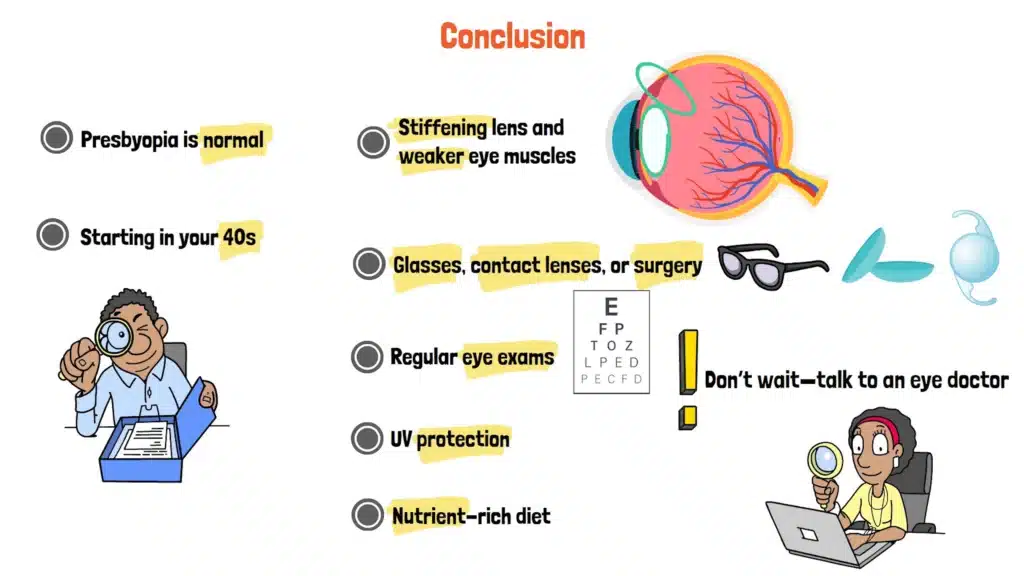
Presbyopia is a normal part of aging that affects your ability to see up close, typically starting in your 40s. It’s caused by a stiffening lens and weaker eye muscles, with age as the main risk factor. Symptoms like blurry close-up vision or eye strain are manageable with glasses, contacts, eye drops, or surgery. Regular eye exams and healthy habits, like UV protection and a nutrient-rich diet, help you stay on top of it. While presbyopia can disrupt daily tasks, correction restores clarity and ease. Exciting research is paving the way for new treatments, so the future looks bright. If you’re noticing vision changes, don’t wait: talk to an eye doctor to keep your world in focus.


